50 Game Round Up: 1-50 (Peter)

Posted: 2nd May 2011 by Mulholland in Round-Up

Wow, I can not believe that we have already reached 50 games. If you would like this in more of a context that means we have now played 1 in every 20 games which does sound a little bit more impressive… so let’s stick with that.

Since 5% seems like a nice value to use to perform some form of round-up we decided that this would be something for us to do. It means that not only can we cast our minds back and do a little bit of reflection but also (to those who come into this blog late) you can get some nice link backs to previous games we have covered.

Best Game I Had Not Previously Played

It was one of the first games we covered but Bayonetta wins hands down as the best game covered so far. It had been sitting in my collection for a while before I got round to it for the sake of the blog since I fell in love with the trailers and the overall concept. Capcom found a way to make this game suitably epic as you fight your way through hordes of rather twisted looking angels using guns, swords and (my personal favourite) a chainsaw. I think I gushed enough when we first reviewed it but I would definitely call it an essential title for the 360.

The fact that this was seventh game we covered does not mean all games that game after it were a monumental let down. Other notable games that came close to being  named the best include Peggle, Quadradius and DJ Hero.

Worst Game


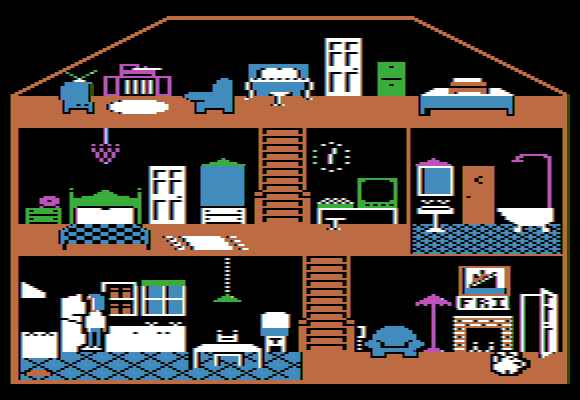
Ummm….yea. Little Computer People was just plain awful. It was said to be a bit of a Marmite game when in fact it played more like tar. I can not imagine a game we are about to cover that would end up being worse than this… seriously.

Most Surprising Game

The title of the most surprising game just HAS to go to Introversion’s Uplink. The fact that a game had been made which attempted to mimic the art of computer hacking is interesting enough… that it was carried off in such a sleek and involving fashion is astonishing.

Other great games where I was surprised at how much fun they were included the RPG Baldur’s Gate II (I can just hear Jeroen cheering), The Last Express and the addictive strategy game Quadradius.

Games I Want To Get Back To


The game which has inspired the most play after their blog entry has been completed is, without a doubt, Lego Star Wars. Despite the fact that is has broken my Xbox a few times it has remained the most played game of the first 50.

However, other games have inspired further delving on my own steam. The games Drop 7, Bayonetta, Quadradius and Second Sight have all been played after we finished writing their posts… but they will probably never surpass the amount of playtime I have previously invested in SSX Tricky and Timesplitters 2. Both of those have been staple games for me over the years and will always remain dear to me.

#432 Baldur’s Gate II

Posted: 30th April 2011 by Jeroen in Games
Tags: , , ,

50th game played so far!
Genre: Role-Playing
Platform: PC
Year of Release: 2000
Developer: Bioware
Publisher: Interplay Entertainment

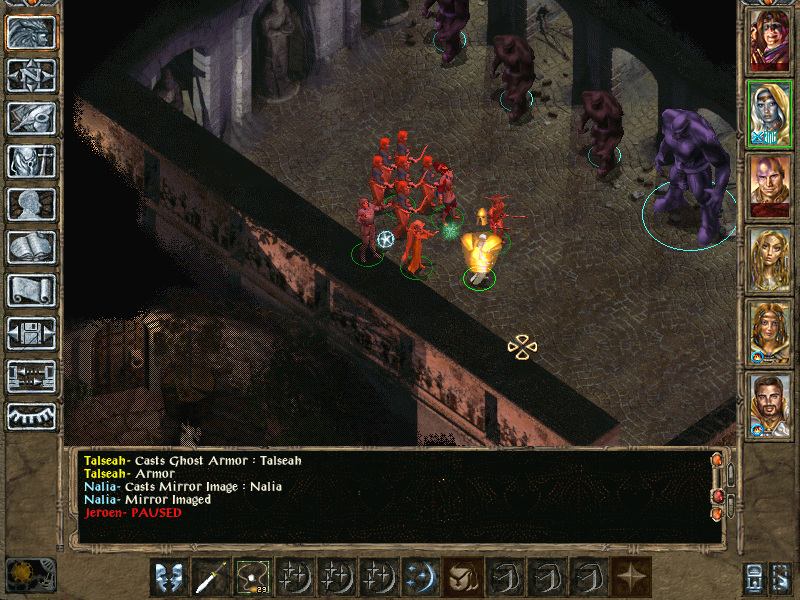
Here we go then, possibly my favourite game (at least at the moment) – Baldur’s Gate II. BALDUR’S GATE II. As it says, it’s a sequel to the first game, which actually took place in Baldur’s Gate. It’s probably the best example of western RPGs out there, and is generally seen as a big one in the genre. It’s got it all – flexibility, character options, plenty of side quests, a good story that, to be fair, doesn’t always matter much because you spend so much time doing other things… and it’s just great fun. But is the enthusiasm shared?

This game uses the same engine as Icewind Dale, Icewind Dale 2 and a game we covered earlier – Planescape Torment.

Our Playthrough

After going through the tutorial (something good to do if you don’t know the game series yet), the unfortunately Irenicus Dungeon and we managed to do the circus tent quest, and started on the de’Arnise Keep.  Basically, do some quests, interact with some people, and see some of the things out there.

Our Thoughts

I’m afraid it’s going to be hard for me to give a completely unbiased opinion on this game. Don’t worry, when you start to spiral into fanboyism (even more so) I’ll give you a nudge. I bet you will with a sardonic grin on your face.

But then let’s start there – what’s less good about the game?

The first hour(ish) was a bit dull to be honest. The fact that you are so constricted in the linear nature of the dungeon gets very trying. In the end I guess this serves to act as a counter-point to the relative freedom in side-quests available as you step blinking into the sun. If it was not for the fact that Jeroen was so much of a fan of the game (and played so many hours on replaying it) I would have become very frustrated with it. The first dungeon does not offer much variation and since you are still coming to grips with gameplay so parts are rather unforgiving.

The first dungeon is boring – not only is it linear, most of it is a focus on the most boring part of the game – walk around, defeat enemies, get loot. There are some good parts that show the character interaction and allow for minor choice, but it’s far less than the real game, to the point where regular players have created a mod (more on those later) to skip it every time. That is one thing that really did get to me… all the walking around. I am thankful for the Ctrl+J mod that allows you to jump across the map. It meant that I got to do a lot more in our traditional 5 hours. Also, since there are 6 in the party, one of them always seem to get lost along the way. A general cheat code, actually, that’s worth turning on to speed it up a bit. Not properly allowed, and walking through the area the first time can be lovely, but the backtracking you need sometimes can get boring. Such as helping out that djinn/genie where you have to trek for what seems like miles to find his blasted item. And have no way to really avoid that… with it being on opposite ends of one of the larger maps, that gets to you.

The only other slightly annoying thing is the walking animations where the characters seem to stop and start quite frequently rather than it seeming more fluid. Then again that is probably more to do with available technology than lack of coding prowess. Something I didn’t notice as much anymore, but could happen… these are simpler sprite-based games, which might have influenced things here. I guess that since you have played it sporadically for the last 10 years it is something you got used to. Then a pair of fresher eyes watches the walking (so…much…walking) and it jars a little bit. Quite possibly true.

Still, other than that, you seemed to be okay with the graphics. Some of the later artwork was great. I loved the look of the circus tent in the main town. Also some of the rooms were beautifully decorated.  In graphic terms this was leaps and bounds ahead of Planescape: Torment (helped a lot by allowing a higher resolution for the game). That is really seen in the player portraits on the right-hand side of the screen.  All of them, except for those lifted from the original game, are much better than how they made Planescape’s Nameless One look. Well, none of them were millennia-old immortals, that would explain part of that; but they allowed for nicer hand-drawn portraits suited for the individual characters (and far more fitting the actual characters than some in the original game). Some of them did give me the creeps a little bit as the eyes are slightly off, Aerie being the ultimate example of this.

A truely disturbed individual she is – she used to be a winged elf, but had her wings clipped as she was dragged around as part of a freak show. No wonder she was such a whiner. Unfortunately so. Most of the characters you meet have some story like that, often leading into subquests or even romances you can get into with them.

Now, the characters are probably one of the most defining features of the game – their interactions with the world and the people in it are lovely and create lots of different personalities – the chatty Jan, insane Minsc and Edwin (no adjective… he’s just Edwin) are all memorable and funny, while the stories of characters like Aerie and Anomen are more serious and feel sadder.

Minsc really did capture the hearts of the gaming community. Even those of us who used to confuse Baldur’s Gate with Dungeon Keeper (don’t ask okay) will have most likely heard of Boo. I mean this is a Minature Giant Space Hamster after all. It’s oh so fun to make him squeak randomly. As he runs away because he’s afraid of you. Without him, Minsc would be far worse off. He’d probably end up killing the rest of the party and making balloon animals out of their entrails. Sadface.

The voice acting helps as well, setting the tone and defining the characters, and often as memorable, whether it’s a bit-character or a major NPC. And for the geeks – apparently the game was interesting enough for Michael Dorn to put in an uncredited voice) I did enjoy the voice-acting, after I reduced the frequencies of confirmations I enjoyed it even more. There is a large variety of noises the characters make but due to all the stopping and starting they tend to get used up in the first 15 minutes. The dialogue, however, is very well performed and is quite emotional in parts. This is especially so with Imoen where you can hear her fear and melancholy. This is quite a change from the happy-go-lucky Imoen from the first game. Then again, seeing your friends murdered in front of your eyes would do that for you. And the knives… knives…

Next, there are the different options. I mentioned the amount of quests and side quests before – all next to the main plot, which you can go on with at any time – and the large amount of exploration you can do. But there’s also the customizability in the character creation, which is quite freeform, as seen in western RPGs. 11 classes, most with several kits, races, and all the options in spell choices and so on.

Since we played this as a two-player run-through one of us took a magic-based character and the other a more melee-based one. Of the remaining party members we then made sure both of us had enough variation that many of the classes were covered.  I really did enjoy firing acid arrows at trolls with my sorceress. Note that that increases the variation too – you have up to six characters with you, one of which (or more in multiplayer) you decide on yourself, and the rest you can pick out of the existing characters. And the spells are awesome – there’s lots of them, with graphics and their own effects. Not all as creative, but often great to use and quite powerful.

The main limitation with spells being that there is a finite number you can cast ‘per day’. In the middle of a dungeon this can get frustrating when you have run out of fire magic to finish off trolls. Although it obviously makes sense as a balancing mechanism, and makes you have to be careful, this is just as much about adding strategy to the game. As well as conforming to the rules of Dungeons and Dragons. Of course, this is clearly a D&D based game – the original being the first in a long time – and it shows all the way through. Mostly following the idiosyncrasies of 2E (low armour class being better), but having some 3E elements having been added, such as the already beloved sorcerer.

In terms of the Western RPG there are few games that can claim to be as influential as this. To many this is Bioware’s magnum opus which, in view of the critically acclaimed nature of their back catalogue, is no mean feat. Considering the scope of the game, and the fact that a lot was left out as the developers game under pressure to release it sooner, it is a remarkable piece of interactive story-telling.

Final Thoughts

What more can I say? Look, it’s a good game. The graphics have their dated moments and oddities, but using sprites instead of 3D models that would be dated by now help a lot – and I personally love the hand-painted backgrounds. The writing and voice acting is great, the music suitably epic. A lot of it is memorable and stays with you – but that could be because I’ve played the game that often. The main thing that makes the game, however, are the characters – in part the people you meet, but moreso the characters in your party, who comment on everything, have their opinions and do go their own way at times. If there’s a defining feature of the game, it’s that.

A note on mods. We played using the Gibberlings 3 Fixpack. There are lots more out there – rather than list them all, I’ll link you to the Infinity Engine Modlist again. One of the interesting solutions for covering the 500+ mods that are out there is the Big World Project. This set of utilities allows you to download and install all possible mods in the right order, applying some fixes and making it easier to do the whole thing.

There’s a number of modifications, although if it’s the first time you’re playing, you’ll want to avoid most of them, as they require expert knowledge or wouldn’t offer as many new things. Still, some could be useful. The tweak packs mostly offer some things to make the game easier – spells are more likely to be learned (else you’d save and reload), stacks are higher (meaning you won’t need to fill your inventory with arrows) and NPC interactions are changed slightly to occur  more reliably, with the downside being they may respond from the other side of the map. It rarely matters anyway.

Second, if you own both games in the series, there are two mods that allow you to play Baldur’s Gate (the original) in Baldur’s Gate II, giving you a better playing experience that is more expansive. The two options here are Tutu and Baldur’s Gate Trilogy. The difference is that the former converts your installation – you can only play the first game – including changing some rules to suit the first game (weapon breakage and experience bonuses being the obvious ones), while the latter preserves your Baldur’s Gate II installation, not just allowing you to play both, but easily facilitating the move from the first to the second game – no importing necessary, no information lost.

Mods to be installed are plentiful, and too numerous to list here – it’s probably best to try them, and shoot me a message somehow if you want my advice.  Just take a look and try it yourself!

#41 Mr Do!

Posted: 26th April 2011 by Mulholland in Games
Tags: , , ,

49th game played so far


Genre: Maze
Platform: Arcade
Year of Release
: 1982
Developer: Universal
Publisher: Taito

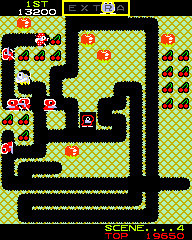
Now, as one of the last in our quest to play little known, obscure games not on the list, we’re going to cover our first ‘Maze’ game, an old variant of Dig Dug where you go around as a clown digging through the earth to collect cherries while being chased by monsters I only saw in my darkest (yet most colourful) nightmares. I will not sleep well tonight.

Our Thoughts

This game is older than I am, unfortunately, although I do remember loving other games in the same genre. One of only 64 titles eh? Yes, a rather significant amount (or so it’d sound. 2^6 titles, oh yeah). As if this blog wasn’t geeky enough. Impossible.

What is there to say about a game where you play as a clown with a cherry addiction? Well, first that the graphics are, of course, dated, but that’s what we should be used to for this. No matter how pixelated they appear to be the clown is nevertheless a little bit scary. He even does the splits when apples fall on his head.

Of course you’ve got some proto-chocobo chasing you, which is as freaking, as well as whiteboards with letters on them. They only appear after you reach 5000 points though (which I obviously did (as did I)).


An interesting thing to note about this game is that there are numerous ways to complete each level (known here as scenes). The ‘easiest’ way to do so is to gobble up all the cherries. You can also complete it by killing all the red monsters, spelling out EXTRA by killing the letter monsters or by collecting a random diamond. You can kill them by shooting them with your mad clown powers or by dropping apples on their head. This is something that I came to appreciate about the game; it gives you options.

It does so in a very simple way, uncomplicated, while adding plenty of options and difficulties. There is quite a bit of variety in the game in that sense – how to win, the enemies, and the different levels, looks and colours. We might expect that from modern games, but not what I’d expect from a thirty year old game. Especially since it owes a lot to fusing the gameplay of Pac Man and Dig Dug (the latter of which was also released in 1982). Making you wonder whether the latter was much of an influence on the game… although possibly the industry was leading here already. It’s possible that they got wind of Namco’s latest game in development and decided to make an opposing title or the success of Pac Man it’s spin-offs created a niche in the arcade market that had already been saturated by shoot ’em ups. Either way could be possible, in either case there is an interesting similarity, and I’ll be looking forward to comparing the two when we get around to playing Dig Dug.

It’s just a pity that Bubble Bobble did not make it onto the list as the dinosaur had a nice cameo as one of the games many antagonists. Or rather, the dinosaur from this game became a main character in Bubble Bobble. Like how Pixar sneak glimpses of future releases into their projects. I doubt the developers were planning ahead that far at the time. Well we will revisit him in the 1994 game Puzzle Bobble. I look forward to his cute cartoon shenanigans. I shall try to remember to wave when we reach it.

Final Thoughts

This is one of those games where it’s easy to dismiss it as a repeat of other games, but regardless of how true that is, the game is tough – proper arcade tough that you don’t see as often these things – but fun and addictive through its fun gameplay that’s more varied than what your first impression would be. Even so, the graphics,while primitive, allow your imagination to become plenty freaked out when you think about I’m already imagining clowns chasing me down hallways, throwing balls and having apples fall on me while I do so.

HELP!

#172 Pang

Posted: 22nd April 2011 by Mulholland in Games
Tags: , , ,

48th game played so far


Genre: Shoot ’em Up
Platform: Various
Year of Release: 1989
Developer: Capcom
Publisher: Capcom

Upon the game’s release Pang (try not to confuse this with Pong) was critically lauded and received numerous ports across all the major consoles of the day. It was lauded for its addictive nature, bright presentation and became one of the indispensible titles for games such as the Amiga, ZX Spectrum and Commodore 64.

Since then it has received numerous sequels including one last year for the Nintendo DS. It really goes to show that once you invent a classic you can milk it for all it’s worth.

Our Thoughts

Now, this game is known under two names, so I have to use both to make sure Google picks up on it: Today’s game is Pang, also known as Buster Bros., depending on where you’re looking or searching. It’s the latest in a long line of Capcom games that we will be covering.  Yet neither of the characters have appeared in the Capcom crossover fighting games. I think they missed a trick there with the player being able to impale The Incredible Hulk with a grappling hook or having giant balloons gobble up other characters as random animals fall from the sky. The sharpened hermit crab was a bit weird.

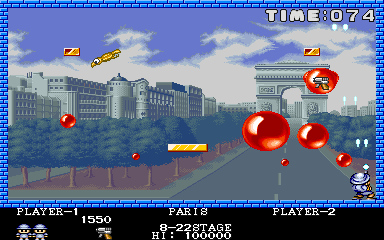
Anyway, more to the point, this is a fun arcade game where you have to pop balloons. The way you are able to do this depends on the power-up you recently picked up.  The basic weapon is of little use in a confined space but it can be strengthened like a piece of cheesewire. Also you can blow them up with some rather brown looking dynamite. This is a double-edged sword as it does not get rid of them completely, instead all is left are the smallest possible balloons which may completely overwhelm you as a player. The best powerup is easily when you stop time. It makes things a lot easier. Unless you’re stuck between balls and can’t get to them. It’s also useful to use the shield, which means you can be hit once, rather than being killed by touching a balloon.

The graphics are good too, very colourful and cartoony, which suits the mood of the game. The location-specific backgrounds are nice too, looking beautiful. There are 17 different locations which feature monuments specific to the area. This includes the likes of Mt Fuji, The Arc de Triomphe and Uluru. Within each location are a number of stages which vary in difficulty. In the beginning the game plays rather simply with the stage being pretty much a blank with just you, your grappling guns and the malevolant balloons.  After a while platforms and ladders are added in so the game begins to play like the lovechild of Donkey Kong and The Prisoner. Making it more of an action game, and both giving you hideouts and places to get stuck if you don’t watch out.

You can see how much arcade games have grown up compared to that first game, Pong. It looks better, has bonuses added, adding interesting gameplay elements and turning this in a game that’s more than just ‘remove the balloons’.

Final Thoughts

Popping balloons is simple, but fun, and the basic gameplay elements have returned in many later (mostly internet) games. And the idea is fun – pop the balloons that fly around and try to avoid them having them kill you. It’s simple, it’s fun… and it gets deviously evil when you get to the higher levels. Suited for an arcade game and something that’s still fun to play around with.

#757 Desktop Tower Defense

Posted: 18th April 2011 by Mulholland in Games
Tags: , ,

47th game played so far


Genre: Strategy
Platform: Internet
Year of Release: 2007
Developer: Paul Preece
Publisher: Kongregate

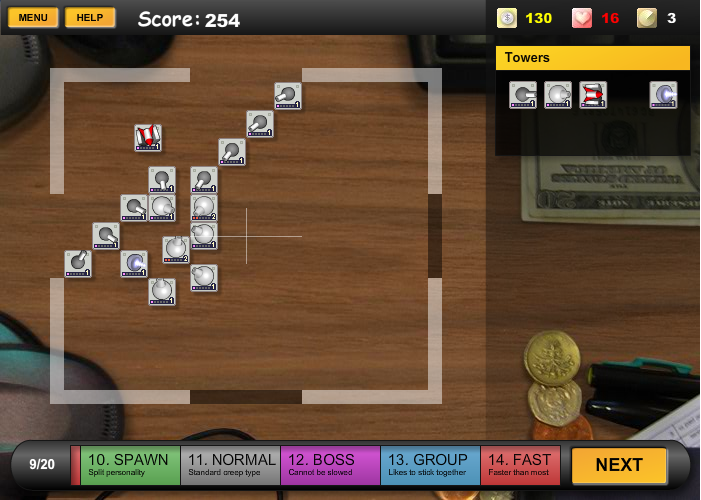
Desktop Tower Defense is a tower defense strategy game with a focus on ‘mazing’ the enemies – forcing their path to change based on the towers you build. The ‘desktop’ in the title isn’t referring to where you play it – instead, the game takes place on an actual desktop, with pencils, coins and other mess.

Our Thoughts

A quick simple online game before we jump into games older than either of us. Desktop Tower Defense is, unlike what the title suggests, a tower defense game. A tower defense is more or less a strategy game where you place towers to prevent your enemies from making it to your base… you defend yourself using towers. I know it sounds simple when I explain it, but it seems to be fairly new (larger) genre, so some, like me, may not know about it.

It’s one of those genres that have become very popular in recent years. Since it’s a fairly simple concept it has been the subject of multiple free games online with many different settings. In fact in a few weeks we will be tackling Plants versus Zombies which breathed new life into what quickly became a clichéd concept and looks more fun. (Zombie week coming up, stay tuned!)

Still, this game is a good game to play. I can’t compare it to other games of this type, really, not having played them much, but this feels like a solid game of the kind. One thing I liked about this game was the different types of guns. Also, it looks like it takes place on an actual desktop. There’s even a large pen in the corner. Not that that makes much sense in the context of the game, but yeah. Other than that, the graphics are actually relatively simple. The enemies are rarely more than circles or triangles with eyes. The towers are simple in design (although some of the better guns look more complicated).

One of the special features of this game is the maze element. The intention when creating the game is to make the tower position matter by forcing the enemies down certain paths and making it easier to kill them as you want that way. Unless they fly… then quantity really does matter over quality. You can’t have it be too easy either… there is a nice variety in enemies. Aside from the usual, some are clumped together, some fly, and others divide up after the first time and need to be killed a second time. The clumped together ones are so deceptive in their volume. Although there’s a tower great at taking care of them, with some nice splash damage.

I guess in the end this does go to show that gamers with no money in their pocket needn’t worry as long as free games like Desktop Tower Defense or Quadradius are still being made. Especially if you just have fifteen minutes to spare, rather than the 150 hours necessary for your fun Final Fantasy game.

Final Thoughts

This is best described as a good, solid tower defense game with the right graphics and solid mechanics. That is, at the same time, all you can say about it. It’s a good baseline game and we’ll probably refer back to it plenty of times in follow-up games… but I’m sorry, nothing to say here.

#673 The Movies

Posted: 14th April 2011 by Mulholland in Games
Tags: , , ,

46th game played so far


Genre: Management Simulation
Platform: PC
Year of Release: 2005
Developer: Lionhead Studios
Publisher: Activision

Despite being quite a profitable genre of gaming it is surprising to note that that in the course of this blog we will only be covering ten titles.

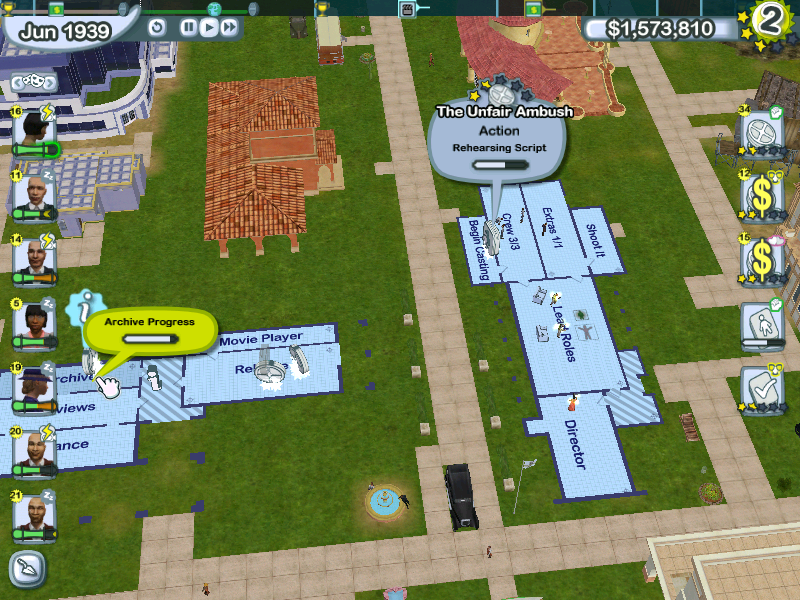
Very few games have allowed the player to manage a media institution without being either average or shockingly bad. Some people will remember the utter bilge that was the Popstars game released on the Playstation 1 in order to capitalise on the talent show’s success. Going against this is the 2005 title The Movies which took a more creative look on how to tackle the management simulation. It was a case where not only could you be the chairman of your own movie studios (ours was Ponyond Productions) but also create your own movies from a vast array of sets, set pieces, costumes and other such options.

Upon it’s original release Activision set up a website where people would be able to upload their creations, alas for it is now shut.

Our Thoughts

The problem with all these games is that they’re addictive. Very addictive. You think you’re playing for half an hour, and it ends up being three and it’s time to head to bed when you wanted to do some coding to fix some important issues (DAMN YOU UNEXPECTED IE9 RELEASE!) Yes… they can be so addictive you end up ignoring your boyfriend for two nights. Not that I am bitter or anything.

It would have been great if it had some LAN capabilities though and had us as warring movie studios. That would have been very awesome, and some future other strategies and simulations will offer that, but right now unfortunately we were constrained with this. Still, your advice was extremely helpful while I was making sure I increased my star power and made the best movies. I like to think that I was instrumental in helping your movie studio get to number one. Absolutely, for as long as it lasted.

It’s one of those games that require a lot of multi-tasking so I guess two brains helped; something that should be praised really since whilst there is a lot of complex elements introduced… but at a well spaced out pace. If everything was there from the beginning I can imagine a lot of gamers taking the CD out of the drive and throwing it into the road. Instead new levels just as you begin to get comfortable.

Casing point, the introduction of ‘custom scripts’ happens about an hour in meaning that you are well versed in running the studio before worrying about original ideas. The same goes for other concepts such as marketing, entourages, research and post-production.

At the same time, it doesn’t feel that way, you certainly don’t get an expanded tutorial feel from this. You just get a few more abilities as you get other things in order and while there are many things to keep track of and do, they don’t get in the way. It doesn’t get too uncomfortable.

When you replay it, however, you do begin to miss certain things that used to signify a hit movie. For the first decade or so you are unable to make a film worth more than one star… and it’s frustrating to see when you have played to a point when you can make films worth 4+.


It’s forgivable though just for the sheer amount of period detail packed into the game. I mean it’s not so much as to look weird but the films you make do feel of the time (to the point where the first film you make feels like Charlie Chaplin’s first attempt). The surroundings help as well. Your stars dress up in period outfits, while the music on the radio (which is on all the time) fits the time period, as do the announcements from the presenter that come through every once in a while.

The radio announcer is amazing. Some of his comments on the business feel very contemporary. He makes a big deal in the beginning about how movies will fail… but as you go along they relent and end up supporting it. The real detail lies in the comedic attempt at ‘current events’ which somehow all manage to raise a titter from the solo gamer. The ones that I’ve seen fitting the time as well – matching real life events – although presented in the way they’d think it would be by then, not how we see the events in our days.

And, of course, they have an effect on gameplay – people change their movie preferences based on it. During the great depression, people want to see comedies, and when a man lands on the moon, people prefer sci-fi. This is helped along by a convenient timeline at the top which gives you advance warning of these events so you can plan accordingly. It makes sense to actually have scripts written in advance just in case. It does, and if you don’t get to use them, they can be sold on. Useful if you don’t have enough stars to film everything.

One thing I actually have a problem with, the ability to acquire actors and directors. You may get so desperate that you train up scriptwriters. It works but takes a long time. Yeah, they show up rarely and even if your studio has a high reputation (which is supposed to attract them) you don’t get quite enough of them. If you are at the top for long enough you are able to poach stars from other studios… but it’s a lot rarer than you would hope. Then there is the fact that you have to deal with the age and possible addictions of your stars. <insert Charlie Sheen joke here> And with them being by far the most important, this gets frustrating. I do like the fact that you can set stars up to make your own power couple. Also, making them have plastic surgery is oddly fun, same with forcing their new fashion statement to be a chicken costume.


Fun fact: you can make furry romance films. Don’t go there. Please don’t go there. How about a sci-fi film where the aliens are people in chicken suits? That might work, I suppose. But still be strange. Still, it’s fun.

As management simulation games it may not be unique but it’s the best attempt yet made in allowing people to run a movie studio. Now all we need would be a similarly great game about managing musical acts and I’ll be lost on the laptop for months. Oh dear. Only if it means you stopping your similar comments about me. Once it has been made you can consider that a deal.

Final Thoughts

Management simulations are very addictive if they are done well. They build up the difficulty as you go along, making it harder. And they provide you with something fun and immersive, feeling you’re playing something similar to the real deal. The radio goes a long way to making this game more fun, but the simulation is hardcore, despite the graphics and creative input in making movies.  A worthy try, regardless of whether you want the complexity of running a studio, the creativity of creating your own movie, or the fun of the game itself.

#49 Archon

Posted: 10th April 2011 by Jeroen in Games
Tags: , , , , , ,

45th game played so far


Genre: Fighting/Strategy
Platform: Various
Year of Release: 1983
Developer: Free Fall Associates

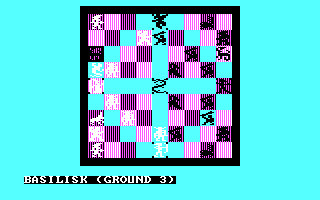
Take chess. Add an extra row to the board, with a few more pieces. Change the looks of them, to divide them visually and give them seperate abilities.  Have pieces battle each other instead of automatically capturing others.  And put in some more strategic options, like having the strength of your characters depend on the colour of the tile they’re on (which, of course, changes). You then have Archon, a strategic fighting game of sorts that might seem like chess-plus, but is actually harder to pin down than that.

Our Thoughts

Here we are for one of the older games for a while, which (to be honest) took us some time to get used to. Fighting and strategy don’t sound like two genres easy to combine, but when you get Battle Chess like I thought it worked when I first played it, you get something more interesting. (Yeah, I started off playing Battle Chess badly). Yes, this is a far more complex game than Battle Chess. When we read up on the desciption I envisaged a game version of the holographic chess from Star Wars. Instead what you have is a game that is chess because of the use of black and white squares, various pieces and the fact that it is turn based. But that’s where the similarity with chess ends, really. When you try to capture a piece, you instead get dropped into a battle interface where you fight the other piece. Your ‘king’ (wizard or sorceress) can use spells to revive pieces, send elementals after your opponents, exchange pieces or other useful things. Then there’s the pieces themselves, which (with their crude looks) represent fantasy creatures like unicorns, basilisks, manticores and golems. Considering the limited number of pixels used they were able to successfully make the pieces look like what they are meant to (the banshee looked perfect). The only one that doesn’t is the unicorn which looked more like a frog. It also raised the question of why a unicorn would be a projectile piece… but that’s a discussion for people in the fanfiction world. This is a 1983 game… obviously the graphics are quite different from the games we’ve played recently, while this game also goes for some more differentiation that other games (like Pac Man) don’t really need as much. When you switch to that mindset, the graphics work and get distinct and interesting enough.

When we look past those ‘known’ issues, the main issue I had were with the controls – it may sound small, but having to press the fire button and then aim to fire is different to what we’re used to, where pressing the fire button just fires. Something I really liked was that there were subtle differences between how different pieces could be played. During the battles you had the knights/goblins which were the melee combatants, the shapeshifter mimiced whatever piece it opposed, certain pieces who attacked with projectiles were slower than others… and so on.

This doesn’t even mention to the strategic elements of the game.  Since the injuries you sustain in battle remain with each piece until the end of the game you need to remember which ones are injured and how much. Also the squares themselves change colour at random interval, the meaning of this being that certain colours granted certain bias. For example if a battle took place on a light square the white pieces would find themselves with an advantage in battle. This means that you need to think before you move as an ill-placed battle can see the loss of a very strong piece. Although your spellcaster can heal your pieces occasionally, which can help them for a little while. You get a real crash course in this from playing single player against the AI which, I have to admit, made it seem very intelligent for a 1983 computer game. The AI has one setting – very hard – and leaves you no chances. I got flattened in my first game and did a bit better on the second, but still lost by quite a margin.

Final Thoughts

The comparisons with chess are misplaced, really. The board layout may suggest such, and there might be some superficial similarities, but when you really look at it, they’re little more than superficially similar, and trying to compare them is futile.

Archon is a lovely strategy game where your fighting reflexes count for quite a bit too, and the two elements combine really well to create a fun game that’s worth playing if you prefer some more action while still having to focus on the strategy, setting up who fights who and how to best get there.

#295 The Logical Journey of the Zoombinis

Posted: 6th April 2011 by Mulholland in Games
Tags: , , ,

44th game played so far

Genre: Edutainment
Platform: PC
Year of Release: 1995
Developer: Brøderbund Software
Publisher: Brøderbund Software

Everyone has their own story when it comes to learning software. I was mostly brought up on Mindmaze in Encarta as well as the games present in Dorling Kindersley titles. For example I played a version of Lunar Lander found in a space encyclopedia programme whose name escapes me. Then there was Reader Rabbit… now he was cool.

Since edutainment has mostly gone the way of various games featuring Dora the Explorer it is fun to look at a title such as The Logical Journey of the Zoombinis which tries to engage the logical pathways in a child’s brain so that they will be better at mathematics… that’s the theory anyway.

Our Thoughts

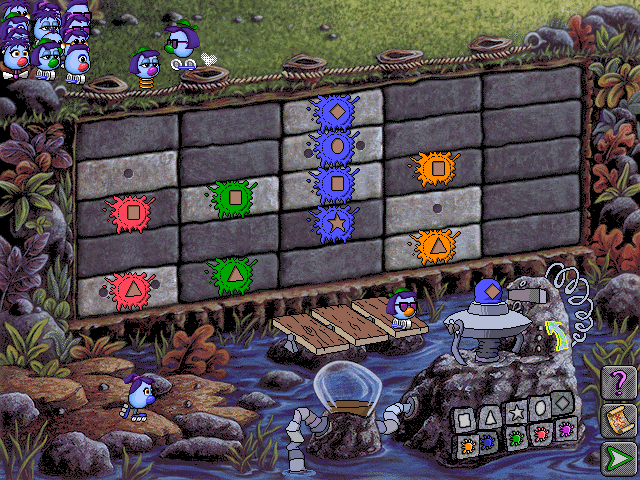
Now it’s time for a game whose gameplay showcases the trials and tribulations of a race, having been grown tired of the fascist regime in their native country, seek out pastures new. However, not everything is smooth for this proud race of blue potatoes mounted on wheels, rollerblades and fans. Oh no, they need to undergo trials and tribulations of lions, frogs and pizza demons in order to reach the Promised Land. If anything this is an allegory for Moses leading the Jews out of Egypt… just with logic puzzles.

In other words, the grass is always greener on the other side, even if the other side involves allergic bridges, pizza-loving trolls and pairing frogs. The fact that bridges can be allergic to certain haircuts is a tad confusing.

I wonder what the kids thought when they sat to play this in their computer labs. Maybe some saw this as a large complex metaphor… who am I kidding. Most of them were probably just happy to get out of learning the state capitals. I suspect this game would have been considered too fun for computer labs for most of them.

It’s pretty obvious that this is an educational game since it is all about logical thinking. Then again… games such as Professor Layton are based on logic puzzles and yet are not considered ‘edutainment’. Despite the use of bright, colourful and customisable cut characters there is not too much of a difference between these games except for the target audience. I mean, The Logical Journey of the Zoombinis is most definitely meant for the 8-12 age bracket but as the difficulty rating increases it is still fairly challenging for some adults. Some puzzles remain the same and others you just wish didn’t exist (yes mirror level my bony finger is pointed at you) but in the end there is a good mix of them here.

The difference here is that this game is clearly intended to teach you the logic reasoning – through specific puzzles and repetition, slowly expanding on the basic concept – the difficulty increasing it a good example of that. A game like Professor Layton is focused on solving the puzzles, and having different ones – there’s no repetition and you don’t continue to focus on similar skills to keep solving more difficult puzzles. With that said, we won’t spoil the puzzles entirely – they are easy to work out and quite fun to do. And if you feel it’s easy at the start – play through them a few times and the difficulty gets increased, in some cases considerably so. Stick with it!

Another reward of its own are the graphics. As said, the zoombinis are made up of blue faces where you can choose between five hair styles, five noses, five eyes and five different shoes/feet. Seeing them move around, and cheer as you win, is cute and quite surprising for some. More so, there are a number of backgrounds and other animations that are gorgeous, with the lion (you’ll see it when you get there) being absolutely stunning. Last, the village you end up at the end is pretty, and gets filled up with more buildings as you get more Zoombinins transferred. It’s worth going through for that.

In the genre of edutainment there are only two other games on this list, and the first of them is a rather dubious entry to be perfectly honest (although the first is also the official first on the list…)

When it comes to teaching children logical thinking this game is pretty much the title of choice and the only one that is remembered. Is it because it’s cute? Is it the enchanting gameplay and puzzles? Is it because of the customisability? All this and more!

Final Thoughts

I am not to ashamed to admit that although I am not in the right age bracket for this game I enjoyed it a lot. It’s one of those titles to save up for when you have children of your own. It also makes for some great Easter egg ideas for a few weeks time. I mean why not create your own cute Zoombini and send them on their merry way? That would be too cute!

#605 Second Sight

Posted: 2nd April 2011 by Mulholland in Games
Tags: , , , , , ,

43rd game played so far

Genre: Action
Platform: Gamecube/PC/Playstation 2/Xbox
Year of Release: 2004
Developer: Free Radical Designs
Publisher: Codemasters

Can you quite believe that we have covered a game from every year in the last 15 years with the exception of 2004? It’s a bit of a strange oversight to be honest so I was able to this gap in our coverage to push forward the playing of Second Sight. I previously owned the title on the Gamecube but, as it always is, I was strapped for cash and as such traded it in. I then found it on eBay rather cheaply so thought it was worth a flutter for one of the select few games that successfully managed to bring psychic powers to a console.

We previously covered the Free Radical game Timesplitters 2 and we will one day be covering another game by them. So, let’s get on with it.

Our Thoughts

It is all too common for developers to pigeon-hole themselves within a particular genre after creating a successful franchise. So when Free Radical, the makers of the classic Timesplitters series decided to venture into single-player action it was always going to be somewhat of a gamble. This was especially so since Free Radical really became noteworthy in their execution of multi-player shoot ’em ups. When playing this, however, there is absolutely no doubt that this is a Free Radical game. This can be seen by the menus, the character designs and (most obviously) the sense of humour.

Of course with this being after Timesplitters 2 (which we previously covered here) everything that these games hold in common have been given a good deal of polish. I can agree with the above, but what is also clear is that this game takes full advantage of it being single player. Through the game, you play through two storylines – before and after – that intertwine, with both having different gameplay with the possible abilities. And the powers you get are so different that you couldn’t easily use them in multiplayer, both because of how and when they’re unlocked, and how many are more focused on solving puzzles and progressing through the game using them.

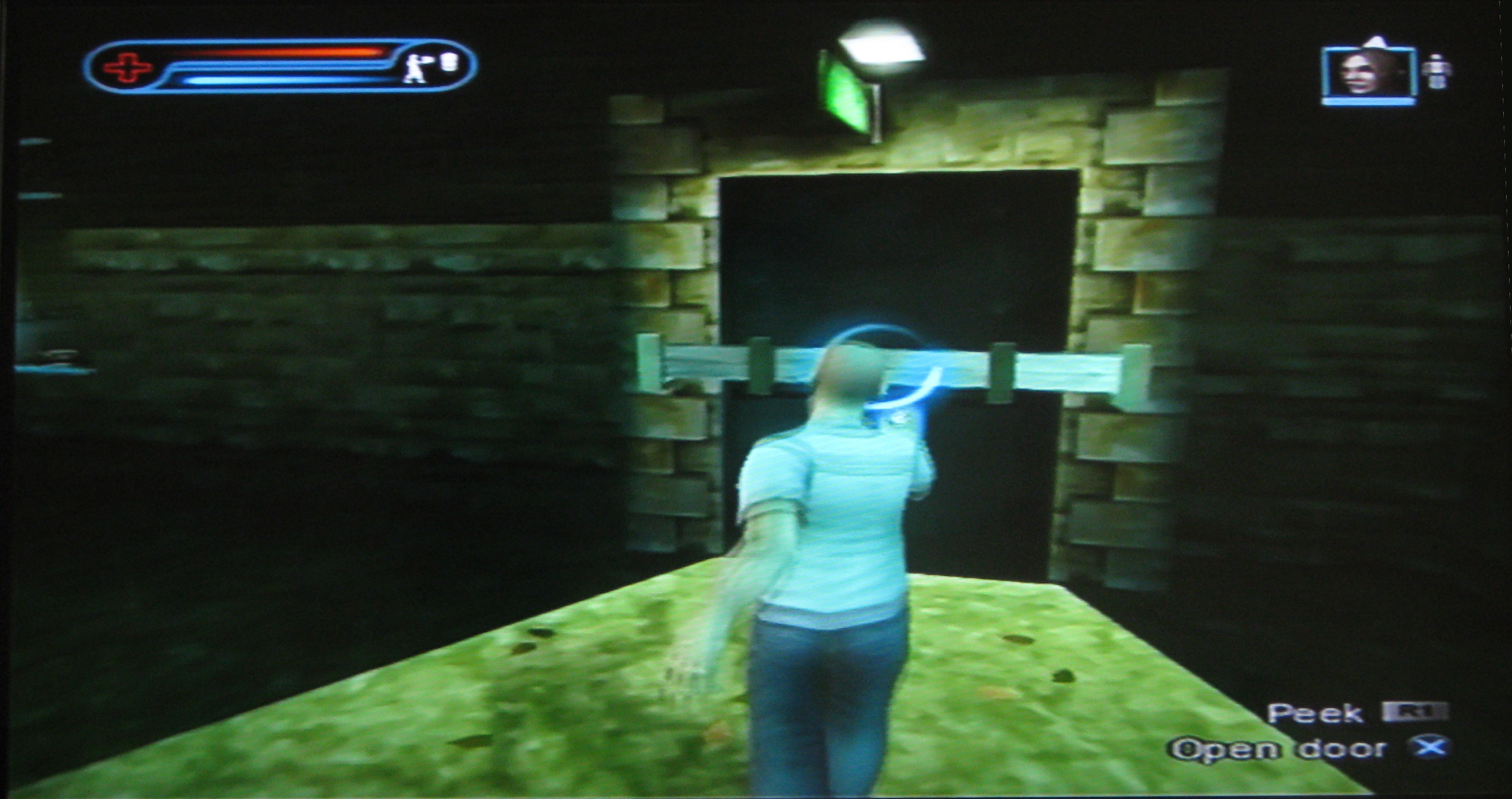
It is the powers themselves which are the game’s ace in the hole. In total there are five psychic powers you are able to unlock (Projection, Telekinesis, Psi Power, Charm and Healing) and these get powered up as you progress further along the game. You can also use weapons which you pick up on your travels such as pistols and submachine guns. An interesting weapon included with these are various strengths of tranquilizer darts so you are able to fight your way through levels without bloodshed. This is not always avoidable but there is the option.

This is something that I love about Second Sight, the fact that there is usually more than one way to complete your objectives. Yeah, aside from the shooting your way through method, you can sneak past as well or use your powers to good effect – either to sneak or to fight. You can ask scientists for help or kill them to get past them.  This is actually made very clear in the tutorial level, where you have to go through the same area  twice – just sneaking through, after that by shooting (with blanks) the guards in the level. There is less of an option when you are playing ‘in the past’ as you storm Russian army complexes in the snow. In this, whilst you are in possession of a tranquilizer gun, it is more advisable to blast your way through. Speaking of which, the shooting mechanics are an absolute dream to play with.

There is something very satisfying about headshots (ah, I love headshots) and the controls are executed so cleanly that they are fairly easy to achieve without the feeling that you are being spoon-fed. I also loved that the sniper rifles had an automatic zoom, something which pays dividends at the beginning of the Rescue mission. I can echo that on the controls, which were very easy to pick up on. I’m not great at these games – not my favourite genre – but Peter had to admit I was actually quite adept and picked up the game fairly fast – in part from practice with other games, in part because I’m actually not that bad with these games and have been informed of such by others, but also because the controls themselves didn’t get in the way. From sneaking to shooting to using powers, they made sense and were intuitive, and with the exception of a slip-up or two, they didn’t ever get in the way.

This game, somehow, even managed to make escort missions enjoyable to play. Usually they are as dumb as a sack of hammers and will happily flaunt themselves in front of the opposition whilst jumping up and down in the air pleading to know what a gunshot wound feels like. This game not only worked out kinks in the AI so that the woman you escort is actually scared and will not run off ahead but also allows you to use your healing ability on her, meaning that unless you find yourself out  of her eye line you are able to make sure her health bar is always as near as full as possible. She’s also suitably creepy and crazy, adding to the atmosphere. But yeah, this is a rescue mission where you do have to escort, but don’t have to worry that much about it either. Yes… some of the dialogue she spouts as you escort her over the rooftops gave me the creeps. Especially when she asks if you are playing a game of hide and seek.

The atmosphere itself was quite good too. The story is divided in two parts, as said, one before the happening that gives you psychic powers, one after that, and the two mix between. The feel of both parts is quite different. In the before storyline, you’re part of a military group and you go through bunkers, strictly designed, as you often see in similar games. In the after story line, you have psychic abilities and escape from a research facility. There’s far more computers around, and parts of it are more technological and more absurd, while others seem grubbier, when you get to the rescue missions and have to sneak out over rooftops and through back alleys. This inter-mingling of timelines is something that Free Radical have always enjoyed doing their games. Whilst it was okay in Timesplitters 2 it was only really perfected in this game.

When examining the output of the studio as a whole Second Sight marks the stepping stone between the second and third entry in the Timesplitters series. It was because of this game that they were finally able to produce a well executed single player mode in their next game. Looking back on this game makes it even sadder that Free Radical went into administration in 2008 resulting in its takeover by German developer Crytek. It marked the end of one of the great small British games developers and since Timesplitters 4 still appears to be shelved we will have to look to the multiplayer of recent release Crysis 2 to see those Free Radical Designs credentials back in action.

Final Thoughts

We have spent a lot of time complimenting this game and mourning the loss of this UK-based developer. This may be a game on the 1001 list but it is never featured on any ‘best of’ lists in magazines so I guess a lot of it really is down to personal taste. It is a game that I love dearly and am glad to have an excuse to play again.

#447 Final Fantasy IX

Posted: 29th March 2011 by Mulholland in Games
Tags: , , ,

42nd game played so far


Genre: Role Playing Game
Platform: Playstation 1
Year of Release: 2000
Developer: Square
Publisher: Square

So here we are, part three of our Final Fantasy playthrough trilogy from games donated earlier. After Final Fantasy VII, the adventures of disjointed steampunky Cloud, and Final Fantasy VIII, or Final Fantasy in a school, we are now back to the fantasy roots of the series, with Final Fantasy IX having you kidnap a princess (sort of) and has you battling mages and sticks to many other fantasy tropes. A different setting, but the one the Final Fantasy designers most want to create a sequel to when they get a chance. Do we agree, though? Here’s our thoughts after five hours of play.

Our Thoughts

That game took a while to get going. Kupo. I most certainly did, kupo, but it finally got going after the first (rather dull) three hours of gameplay.


In particular, after we got through a rather annoying Ice Cave dungeon. I don’t think it helped that the first member of the Black Waltz was a rather tricky customer. It really did help when we got in a bit of exploration and found better weapons and abilities, the fact that we went into trance (this game’s version of overdrive) about two turns into the sub-boss battle.


However, it took us three tries to get that far, and with a rather boring cutscene before the battle, it got annoying. Still, we made it, and it felt like a true victory. The moment that ice/dragon/snake/bastard thing fell to the floor there was a minor ripple of joy felt amongst us at Pong and Beyond. There might have been some audible cheering.

I don’t think it helped matters that we had played the previous two Final Fantasy games in the last month or so. Both of which are regarded critically as being better outings of the franchise. In a way a rash comparison was always going to happen. This is grossly unfair since every Final Fantasy (whilst maintaining some hallmarks) are essentially different games with new character, surroundings and mythology. In fact apart from Moogles, Chocobo and the name Cid there are few thematic elements which regularly reoccur in the series. In a sense, this game goes back a step by actually having a fantasy world (with some steampunk elements) where the last two games were fully steampunk, if not getting closer to sci-fi.

With the exception of the airships powered by ‘mist’ there are very few prominent machines in the earlier reaches of the games. There are some which will not be mentioned here for the sake of preventing spoilers. Trust me – this time there’s no trains. As opposed to the train fetishes from the past two games… god, they could’ve called it Train Fantasy then… If there had been gratuitous shots of trains entering tunnels then I would agree with you… but no.

Anyway, the fantasy world is nicely worked out, giving magic a larger role and involving it nicely in the larger plot. In that sense, the game is also far more simplified – unlike the earlier games, you just set what abilities you want to learn (based on your equipment and the character) and it happens automatically. No junctions, magic assigning or anything else, instead a simple system that forces each character to play its own role. No long tutorials needed. The only tutorials you get are at the hand of a wise Moogle. These are portioned during the first 4 hours of gameplay and are given in a very straightforward manner (and, thankfully, short). If here are any troubles or questions all you need to do is hit SELECT on the menu screen and there is a short description of what it is you are looking at. The adjustment of the learning curve is a welcome relief after VII and VIII.


There is a lot to be said of a well done simple system compared to a unique but complex one. It also helps that Final Fantasy IX saw the introduction of who may well be the cutest and the saddest and funniest character to ever grace a JRPG; Vivi. One of the members of the Pong and Beyond team might be pushed out in his favour, following several “I love Vivi” squeals. This is only because Jeroen does not possess a large floppy hat and get easily flustered. Only sometimes.

At the beginning I found Vivi a touch annoying but he’s the character who I was able to easily connect with during the gameplay. The others seem to be either stock characters or (in the case of Dagger/Garnet) remarkably dull. I wish we had gotten as far to the introduction of Quina Quen as they look rather unique. Steiner is the goofy tank character, who’s incredibly loyal, and stole my heart with his antics as well, making that another favourite.

Unfortunately we’re unable to spend that much more time on the games, although I’m certainly considering going on to give it another try later (once I can get access to the games then). The main problem with the game that nearly made us throw it out early is that the game starts off incredibly slow. (Something that partially applies to the start of the battle… loading times are awful) For the first few hours, you don’t have a reason to connect to the characters. They’re stereotypes involved in a simple ‘Kidnap the princess’ plot. The personalities seem generic and while there’s some clever wrapping, the plot itself doesn’t drag you in.

It’s only when the more macabre side of the game begins (involving the factory line production of black mages) that it begins to work out. This does not exactly make up for the large amount of blank screen time that occurs during gameplay but it does mean you are looking forward to what’s on the other side of the blackness. Except for the battles… which are a colossal pain in the behind sometimes. Yeah. The battles are slow anyway, but the black screens before we can even start takes a long time and gets annoying. And when you’re in the battle it’s slow enough that everyone else has gotten their turn again once you have played out the animation for one character.

Speaking of cutscenes, the gap separating the graphics is remarkably reduced compared to previous outings. By the time we reach Final Fantasy X the gap is nearly gone. Yeah. The graphics have greatly improved again. While Final Fantasy VIII went for realism to make the game look better for longer, here they go for a similar art style to Final Fantasy VII (though less exaggerated), but executed in a way that looks better even now. It looks pretty good if you ask me. Unfortunately we didn’t get far enough to see any summoning graphics (which could’ve been interesting), but all spell animations we saw were impressive.

I think the mage animations on the whole were impressive. Zidane was probably the east convincing of the bunch… but it didn’t help that he was some sort of monkey-boy thing. He was supposed to look different, something that they were going into further. He still looked distinctive and interesting, and certainly didn’t stand out as such a bad design. In cut scenes though he was graphically the worst rendered if you ask me. Yeah, unfortunately, but not too badly so in what I’ve seen.

Last comment, the music. The battle music, at least, wasn’t as inspiring as in any games. It didn’t fit into the feeling of the game at all. When you are in a slightly quaint village you wouldn’t expect the intrusive synths. We played with sound turned down for most of the game for this reason. It wasn’t inspiring or felt right, it didn’t work well here.

It’s a good game once you give it time – something that isn’t too bad considering this game will easily take you 20-30 to get through fully – but you need to have the persistence to have it grow on you.

Final Thoughts

So that’s it. The game is lovely – great graphics, several adorable characters and an interesting setting. It’s slow to start, and later on especially battles are rather slow. Once you get past the first dungeon, however, things pick up (or at least they did for us) and you get into an intriguing plot where anyone who doesn’t like Vivi can’t be called a decent human being. Nobody has to like Dagger, though. We’ve seen too many spunky princesses for that.