#450 Tony Hawk’s Pro Skater 2

Posted: 8th August 2011 by Jeroen in Games
Tags: , , , ,

75th game played so far
Genre: Sports
Platform: Various
Year of Release: 2000
Developer: Neversoft
Publisher: Activision

Although I suppose it might have vaguely resembled my former social groups, neither of us have been into skating, really. At all. It just never appealed to me. I prefered doing things where I didn’t have to worry about big falls and fast speeds. I’d rather not run the risk of breaking my neck during entertainment for vague tricks.

This game always had a big hill to climb, not helped by the fact I have no real clue what an ollie is or why you’d grind… at least in this context. It will be interesting to see whether this will pay off.

Our Thoughts

I still cannot quite get to grips with the fact that you hung out with the skater kids. Although I guess it does explain the Avril Lavigne CD. Not directly skaters – none of those around that I remember – but the general music likes and such, yeah.

I remember when this line of games first game out, there were a large number of celebrity endorsed sports games on the market. Activision made a mint out of using the names of big names in niche sports such as surfer Kelly Slater and BMXer Mat Hoffman. Or indeed Colin McRae, to go back a game for a moment. Of the Activision endorsement group it was only the Tony Hawk games that appear on this list (twice in fact). It’s a bit of a pity really since I would have loved to play Extreme Ironing with some D-List celebrity. And wine drinking, I’m sure. Still, as might be obvious, these games usually disappoint, selling on celebrity power instead of good gameplay. This is obviously not the case with this game, it was lauded by every gaming publication upon its release and is still ranked amongst the highest rated games of all time.

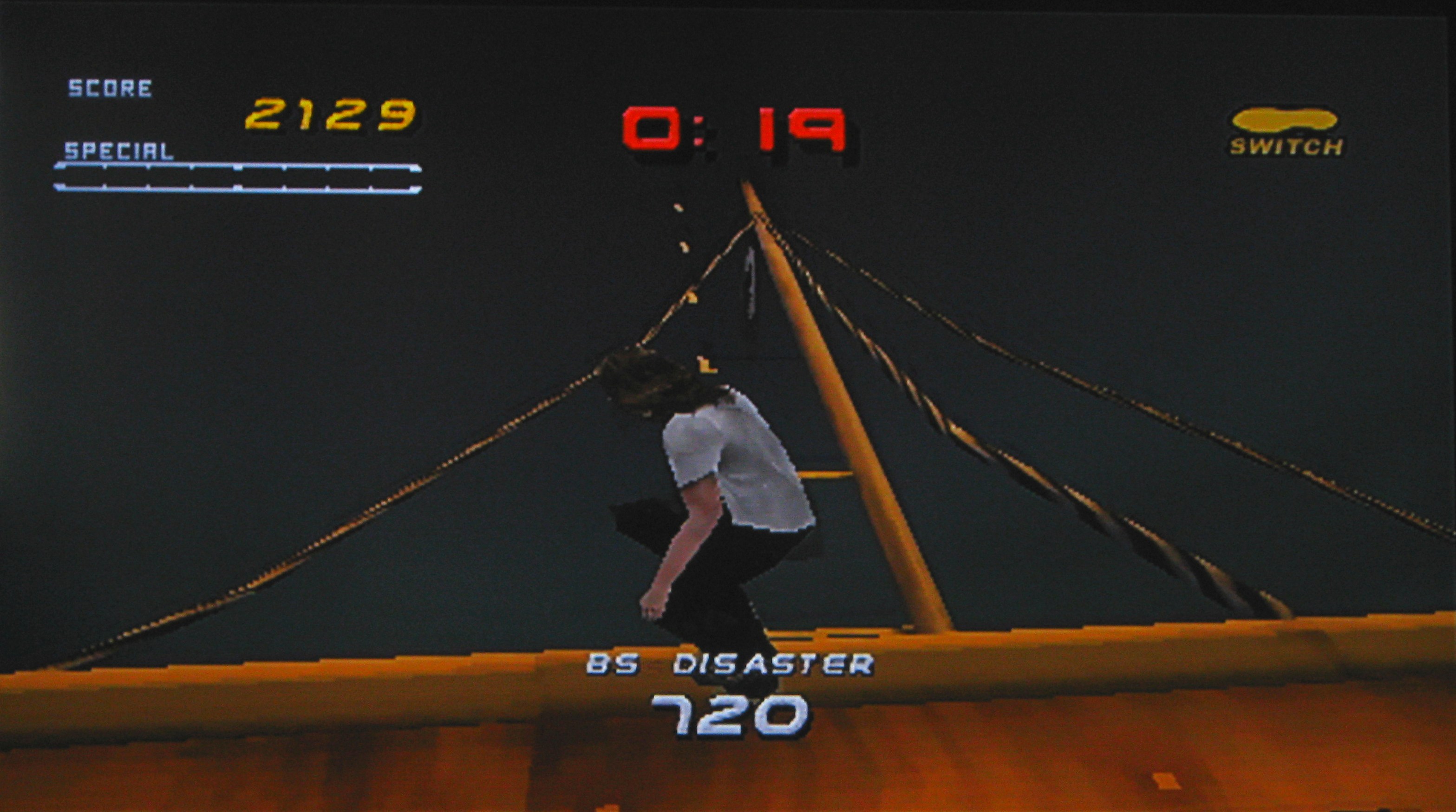
Since we have given the great compliment let us now discuss how this has not stood the test of time: the graphics. Now, we are always fairly understanding when it comes to games when compared to it’s contemporaries but when you consider that this was released just one year before Gran Turismo 3 the difference between the two is startling. Granted this is a year that crossed console generations but, looks wise, it is fairly poor.

One thing where this really stood out were the models of the players. They were clearly trying to get some sort of photorealism here, but didn’t have the technology to do it, making the faces be more a blurred mess of pixels. Textures of your surroundings, at the same time, are fairly low resolution, drab and repetitive. You can get lost not knowing where you are again due to most places looking similar. The only places where this was not the case was the Hawaiian Helicopter Drop level and the one where you are skating on the moon. I mean it is all well and good saying that you are skating in New York City but when the level could easily be Nowhere, Indiana it doesn’t make much odds.

Yeah, and while there’s some interesting ideas here and there, it doesn’t always join together nicely. It doesn’t feel like that much of a normal place… even in an outdoors environment, it feels more like random set elements put together that sound cool. Skating in a bull ring is weird especially when the bull is taller than the skater.

One thing that can be very daunting about this game is the complexity of the trick controls. Being able to execute a fantastic trick takes a great deal of control as otherwise you may end up flat on your face with blood spurting out. Pity that this game was not advanced enough for the blood stains to remain on the ramps throughout the entire level attempt.  Not helped by the fact that tricks are a combination of directional control and the relevant trick button. Because of the difficulty there, you do indeed end up falling down repeatedly. It is fairly difficult to finish the tricks too – obviously the important bit – and it’s a good thing the walls seem to be made out of foam, as all that happens afterwards is that you get up and go on, while your skateboard magically reappears under you.

In the end this game has a very specific target that it wishes to hit – and it is neither one of us. Gamers who are greatly into sports games or are actual skaters will end up being huge fans of this game, as well as others in the franchise, due to large number of skater professional namedrops and the severe level of detail that has been paid to it. Once you master the controls you are able to earn tens of thousands of points buy stringing multiple tricks together. You need to possess the drive and the general interest to play this again and again in order to master every nuance but, as I have been told, when you have the drive this is one great sports game.

Final Thoughts

It’s a double feeling. Yeah, this game is a good skating game. And I’m sure there’s a lot of enjoyment to be had when you get into it. But if you’re not, it’s not great. The graphics are a bit behind, the sound has good music, but nothing outstanding, and it just all makes it less interesting if you don’t care greatly about the skating games.

Nice ten years ago, not anymore as much. If you like skating or such things, do so, else it might be better to avoid this game.
#464 Gran Turismo 3: A-Spec

Posted: 4th August 2011 by Mulholland in Games
Tags: , , ,

74th game played so far

Genre: Driving
Platform: Playstation 2
Year of Release: 2001
Developer: Polyphony Digital
Publisher: Sony Computer Entertainment

Between the two of us there is probably no genre of video game that we can not cover with grace and enthusiasm… except for realistic racing games. Despite one of us having links to the world of rally car driving (hint: it’s not me) neither of us are that interested in cars in either the gaming world or the real world. I mean the only reason we watch Top Gear is for the witty banter and challenges rather than the varitable autoporn.

Howvever, this will not stop us from giving this, what is viewed as one of the best driving games ever made, the same treatment that we have for games which tickle our personal fancies.

Gran Turismo 3: A-Spec was called a the PS2’s “killer-ap” upon release and it really helped to define this console’s image when compared to it’s contemporary consoles. This is expecially so since the Xbox was yet to see the light of the public gaze.

Our Thoughts

Despite the fact that I wrote the introduction to this game it was not me that got to know it’s nut and bolts. True, I played a number of races and actually did better than either of us expected but this was truly a Jeroen game so I will be leaving most of this to him. Part of this seems to have been thanks to my family history. As you can clearly see, this is a racing game. I haven’t driven a car in nearly a year, to be honest, although that doesn’t immediately apply to these games anyway. But my father had a lot more experience than that anyway. Mostly a car mechanic, he’s been on severaly rally races as a mechanic to help out, and even was a navigator in some of them. Mostly exciting, although there were some narrow moments that barely kept him out of hospital. So yeah, all of the things in the game made a bit more sense to me, even if it’s never been a great interest. Which explains why you immediately tried to buy an Alfa Romeo. Absolutely. It’s the family favourite, and my dad wouldn’t have wanted me to do anything else.

You see, Gran Turismo isn’t just a racing game, where you get dumped on a track and do your rounds. No, you need to buy your car, and with the money you have left and that you earn from your racing, you need to tweak your car. Install a turbo, add a lighter body, change your tires, make sure it all works best together. Even down to you being able to wash your car between races, should it be necessary. The range of options is huge and quite overwhelming at the start. It’s worth taking your time to consider. In the end, however, you do have to race, and that’s where my errors are exposed, not having the right fine-tuned control over the PS2 controller just yet. I guess that this is where our lack of experience in the racing/driving genre (someone explain the difference to me) shows. When it comes to games like Mario Kart Wii and F-Zero X I am always up there near first place when against the PC… but when you actually need to give a damn about oil, breaking and tyre tread then we both come slightly unstuck. Well, you do. I actually did better here than I did with the other games, possibly showing some results from my genes after all. Also, I doubt either of us considered Australia as a powerhouse of car manufacture.

What also helps is that, so far, we seemed to be mostly indestructible while racing. To be fair, most race tracks aren’t delined by rocks and mountains, but more often walls and tires that absorb an impact better, but even then we can mostly just keep driving on in this game. If this game had been slightly more realistic then I would have regularly been sans wing mirrors nearly every attempt I made at racing. Absolutely true, and the amount of bumping off the road – often thanks to your opponents wanting to stick to their racing line without taking into account that you’re driving there.

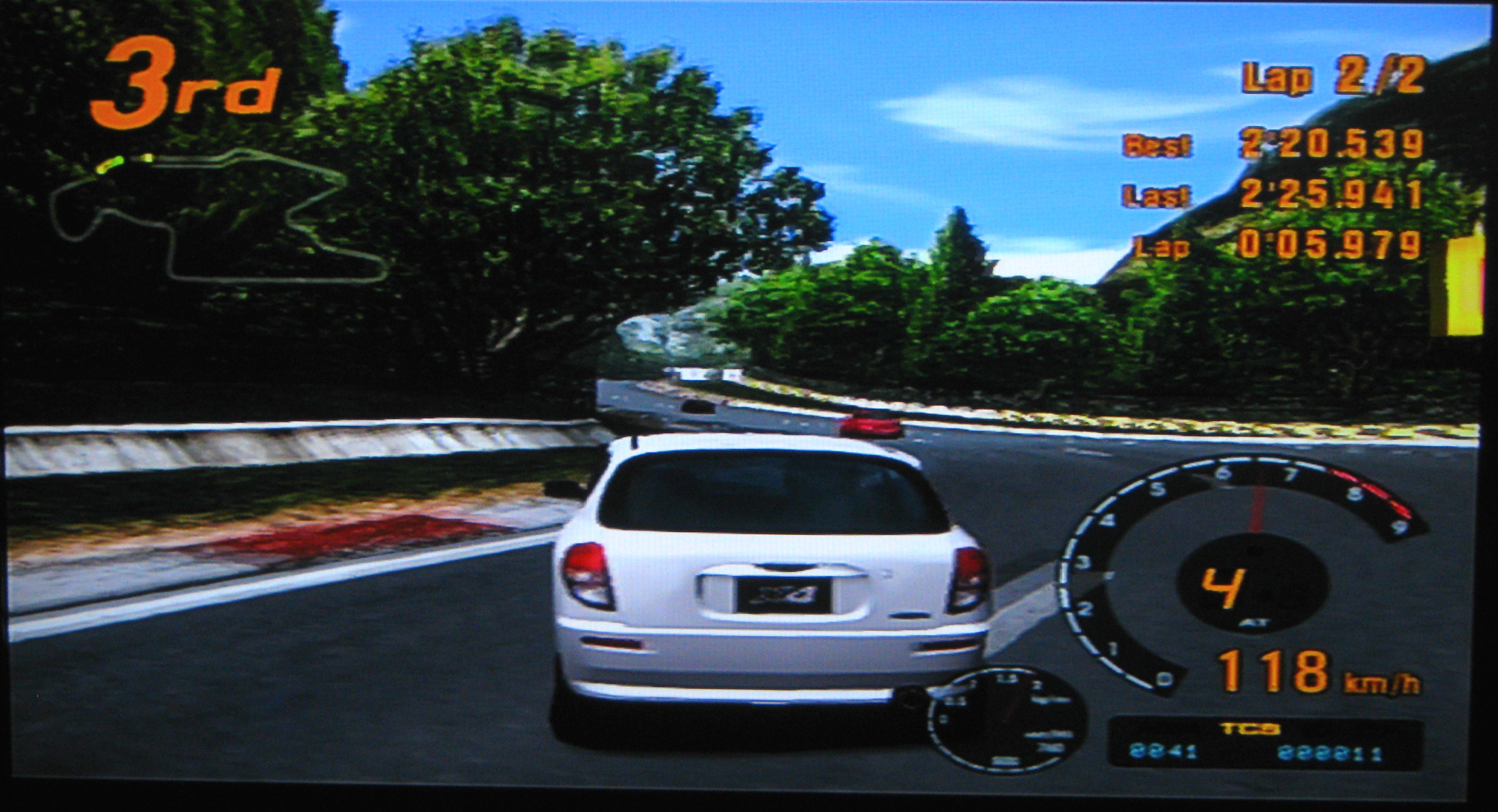
Despite the fact that this game was realised near the consoles release date I have to say that I am surprised how crisp and polished the game looks. Ten years later the graphics and sound are still pretty decent. Some parts of the world look a bit dated – the audience itself was more just some white and red dots, rather than something that might look a little bit better – but overall it looks nice enough. It helps even more here that you don’t have much time to pay attention to the graphics anyway, as you need to pay attention to staying on track. The sound is better in that sense, although you mostly hear the cars anyway. There is background music – a good soundtrack that fits in well, with mostly rock influences – but the engine sounds themselves are quite loud and are more important. If we did a direct comparison between this game and a recent one (such as Dirt 3) then we would definately see a big difference when it comes to aesthetics, but this was head and shoulders above other games released at that time. And it shows. The game, despite our lack of interest in the genre, is a good one, and I found myself racing a few more laps after I just tried some customizations… just so I could see how it’d go. Also, the amount of unlockable cars and races available would keep an avid fan occupied for months.

Final Thoughts

In total nearly 15 million of this title was sold around the world making this the second highest selling game for the PS2 after Grand Theft Auto: San Andreas. Since neither of us are really in the position to judge the merits of racing games in relation to others then this is the last we’ll say about that and we apologise to those who disagree with our opinions… but thems the brakes.

73rd game played so far

Genre: Action/RPG
Platform: Gamecube
Year of Release: 2003
Developer: The Game Designer’s Studio
Publisher: Nintendo

Before people wonder, no, this wasn’t the first or only Final Fantasy spin-off. Although I’m sure there’s others out there, two larger ones I remember preceeding this is the Gameboy Final Fantasy Adventure, which reflected this game’s action-based in-game battle, vaguely resembling Zelda. The other is Final Fantasy Mystic Quest, a western-focused Final Fantasy branded game that’s simpler and more focused on action, set up as an easier version for those not into the number crunching and complexity of other Final Fantasy games. Next to that, there are also other more recent famous series like the more strategy-based as Final Fantasy Tactics games.

Crystal Chronicles is a more recent game that involves a simple action interface, again similar to Zelda. Travel around with your caravan and collect myrrh. This is good for your village and advances time. It’s very important. Obviously. As any Final Fantasy game, except more actiony.

Our Thoughts

In preparation for this game we invested in a pair of GBA Adaptors for the Gamecube so that we would be able to do our playthrough in multiplayer mode. Granted two of our previously covered games (found here and here) would have been supplemented by such a peripheral accessory but this is the first one on the list which has a large effect on gameplay.

This is a game that was clearly developed with the GBA in mind. While it plays well without it if you play on your own, the GBA adds radar to help you explore, as well as providing easier access to the inventory and other menus. Which is why it’s needed for multiplayer – without it you wouldn’t otherwise be able to set up your character and skills. With the recent announcement of the Wii U at E3 one cannot help to see these games as possible precursors to test the waters. Ten years later… Clearly we needed to get to the point where the hardware caught up too. The announcement makes sense, and it’s going to make gaming great. This game showed it.

So yes, this is a roundabout way of saying: this review will be biased towards the multiplayer mode.

One of the things where this showed up were the minigames. By collecting Moogle stamps when travelling around the world, you get access to different minigames that you play against the other players – obviously on the GBA. They worked nicely as a distraction and change of pace, even if the main one we played, the racing game, also had some issues with control – they are clearly simple minigames that need to be small to make it to the GBA.

Luckily control issues don’t affect the actual game, which is simpler than the five layer nested menu you see in some Final Fantasy games, limiting it to moving between four control options (a number you can expand later), attack, defend, and two options that you can decide, becoming spells or items. You use them with ‘A’, while ‘B’ allows you to interact with the world. This mostly turns the game into button mashing for a melee-based character, but ranged attacks are possible as focused attacks, and obviously spell casting allows you some more options.

At the beginning of your journey to milk myrrh trees (seriously, what drugs were involved in the game’s conception) you get to choose between four races which have different battle statistical leanings. When playing this we chose a character that prefers magic and one that was meant to be faster. The fact that the female version of my character looked manlier than the male version of the other race is a bit of a comment of boys in Japanese animation. But you don’t have to be too rigid about how you approach each character as after each level you are able to level them up for their different characteristics. Still, as a spell caster I came to enjoy the fact that there is no MP involved and that the only side-effect is the time taken to cast spells. Something that at times affected melee attacks as well, which is quite slow at times as well. Especially the focus attacks.

I also enjoyed how the spells can be combined to make different ones if they are cast at the same time. This allowed the makers of this game to involve large numbers of the spells in the canon such as Gravity and Holy (with the notable absence of the Water-based attacks).  In fact, it seemed like quite a few combinations of spells created Gravity from what we tried… Well there are a lot of combinations. Most of them clearly weighing you down …not even worth a tumbleweed.

Anyway, one thing I really to enjoy were the different settings for each level. With the exception of the Miasma Levels (which, for something threatening, turned out to be a bit bland) they were all distinct and greatly helped to develop the atmosphere. Despite the fact that these are now graphics you would expect to see on the current generation of portable gaming devices it still looks incredibly inviting, goes to prove that you don’t need the latest graphical innovations to set the scene. (It’s worth mentioning here that the Crystal Chronicles series has also been appearing on the DS with Ring of Fates and Echoes of Time).

I would like to now mention this games incarnation of the Moogle. Whilst they have been a long staple of the series (along with the chocobo) this has to be the cutest I have ever seen them… being all sweet and pudgy in their little cosy abodes tucked into their fluffy beds. Aside from appearing in a collection side quest, they also have larger roles in other parts of the game, such as the Moogle who features as the game’s tutorial.

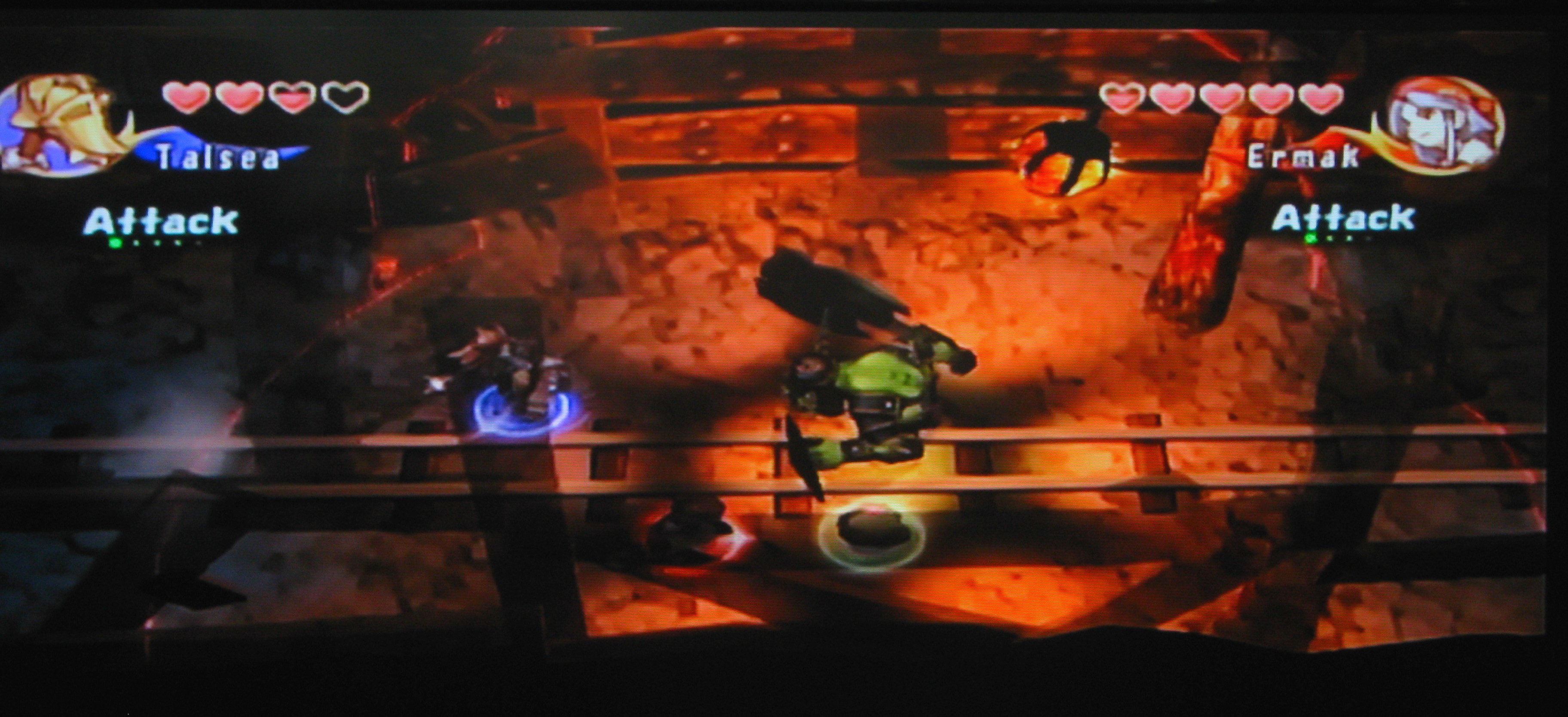
We just lost Peter to Moogle-love, so I’ll go on. The areas themselves are gorgeous too. Varied environments place you in forest, firey mines (where you need to cross bridges to get to some bonuses) and even an area made up solely of giant mushrooms. Sorry, just being appalled by the Moogle designs in Final Fantasy XIII.

Either way, I think that it is safe to say that this has become the most successful spin-off of the Final Fantasy franchise due to it being a nice diversion from the more in-depth RPGs. Now I am looking forward to trying out Dissidia.

Final Thoughts

Is this a complex game? No, not really. Not when compared to the regular games in the franchise. Not in gameplay mechanics, not in story, not really.  What it is, however, is a very fun game. Very pretty in place, difficult but far from impossible and with a large variety of environments.

This game, however, works best as a multiplayer game. If you still have a GBA, get a link cable (it’s only a few quid on Amazon) and play it together with friends. It’s absolutely worth it and really makes the game. One of the few multiplayer Final Fantasy games… how can you resist?

New server and URL!

Posted: 30th July 2011 by Jeroen in Uncategorized

Yes, we’ve gone ahead and done it. We got the domain, we got the server (well, I had it around anyway for other sites, but I might as well make more use for it) and we had the capabilities, so we moved the Pong and Beyond blog to our own server.

We’ll still need to adjust some things, but mostly the important stuff (our chatter) should have been moved over. So from now on, please follow us on our new domain: http://www.pongandbeyond.com/

#676 Tom Clancy’s Splinter Cell: Chaos Theory

Posted: 27th July 2011 by Mulholland in Games
Tags: , , ,

72nd game played so far

Genre: Stealth
Platform: Oh so many
Year of Release: 2005
Developer: Ubisoft
Publisher: Ubisoft

Just as soon as we had taken off our infra-red specs it is time for another stealth game to have its credentials checked out by us at Pong and Beyond.

When it comes to the Splinter Cell games I am probably one of the many people who actually thought that since the Tom Clancy name is attached that he had written the book this was based on or that he had some sort of creative control… but no it’s an endorsement only job since he is such a powerful name in the world of espionage fiction.

In any such event, we will be covering a few games in under the Tom Clancy umbrella.

Our Thoughts

So here we are, the second stealth game in a row. It’s hard not to compare the two right now. Since we are looking at the big Asian stealth series versus one of the big Western franchises it is only natural. And for that it’s a good thing we’re playing these two this close together, as the differences show. Overall, I felt this game was more fun and better to play. Controls? This game felt more intuitive throughout, helped with some simple on-screen prompts. Missions? More varied, optional objectives and a completion based on how you do. Graphics? Just a step up. Since this was released a year after Metal Gear Solid 3 you would expect a step up in graphics and sound.

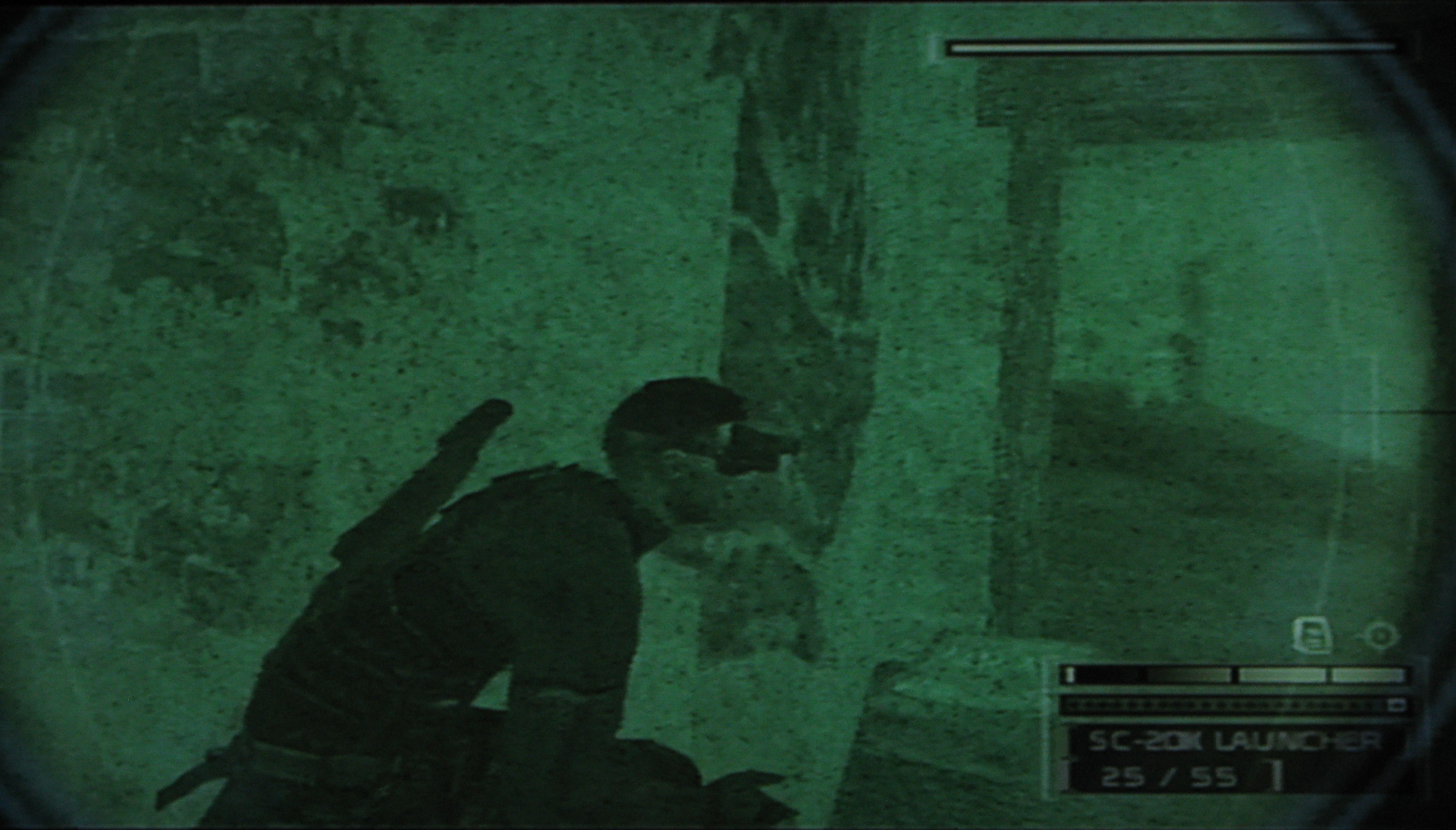
The area that this game shines is, no pun intended, the use of dynamic lighting. This acts in a similar way to the camouflage rating in the Metal Gear Solid game except, since there is no numerical rating, so much more of the actions is up to personal judgement. Since we have yet to play the older Splinter Cell game on this list it is hard for us to know what is new and what is a new addition so expect this to cover aspects of both. The thing that I really loved was the sheer wealth of options available at any given moment during the missions. If you do a bit of exploring you may be able to find secret crawlspaces to help you navigate undetected.There are many options related to enemies; kill them or not, how you dispatch them and if you choose a lethal course of action or not. This is a stealth game at heart but you can go in all guns blazing if you so choose. Or… you can hang from the rafters and descend on your enemies like a trapdoor spider. Or sneak past them. If you sneak up to them, you can grab them from behind, knock them out or kill them. Knocking them out is cleaner and gives you more points. More important when there are civilians that you don’t want to kill.With all that, the map is indispensable, although due to the 3D nature of the levels, this isn’t always as useful. Levels and connections between rooms are confusing, making the map only useful as a general guide. Luckily it’s generally not too hard to find your way. It works well since while it feels non-linear in many ways it is linear enough to prevent you from fumbling in the dark for too long.

Part of it is the many things you can do in theory. Before properly started the games, we sat through the training videos that serve as a tutorial – just simple movies that explain the actions you can take and show how to execute them on the controller.  This showed lots of options and did feel overwhelming, but once we actually played the game, it felt quite intuitive and worked well. There’s a bit of searching involved, but that was only a minute or two. Compare this to the trouble that we ended up having with the last game we covered this was a welcome relief. It’s all well and good explaining how to use the gun but indicating the L1 button is a lot easier than saying “use the shoot button”. I have no idea why games would ever choose the latter option since it is not a language difficulty but it was good to see Ubisoft keeping it simple in that respect. And by using an on-screen representation of the controller, it didn’t even need to break the fourth wall, or make you wonder which button L1 is again. It’s just the left small shoulder button.

As you can probably gather, we played the PS2 incarnation of this game. Since this has been ported to ten different systems (including one for the 3DS) the popularity of the title speaks for itself. It’s easy to see why. It’s fully focused on stealth gameplay, allowing you to do everything you feel you should be able to do while crawling through dark corridors and doing your extractions. This is what you want a stealth game to be.

Final Thoughts

Since our only exposure to the stealth game genre is via the Metal Gear Solid and Splinter Cell franchises it is probably not a wise move to make an over-arching generalisation of the genre at the moment… but if we did I would have to say that it is pretty close between the two.

In the end though if I were to be forced to choose between the two franchises I would so far have to side with the Metal Gear Solid one… it is just more immersive despite the fact that it does not deal with stealth in as satisfactory a fashion.

71st game played so far

Genre: Action
Platform: Playstation 2
Year of Release: 2004
Developer: Konami
Publisher: Konami

We’ve played a Metal Gear Solid game some time ago, and we saw it as a good stealth game… though with its flaws. Now we get to the third part (we’ll do number 2 another time), and this time it’s a prequel to the series – back to Snake’s first mission. And this time it’s in a Soviet jungle (apparently they do exist), where you need to rescue a scientist – that’s what you need to do to them.

Does it make for a good game? I must admit I’m writing this while Peter is playing, and it does look pretty. That’s one pro…

Our Thoughts

Was that you labelling me the superior gamer? I’m flattered. In the sort of games that don’t feature auto-pause, turn based combat or ‘shoot everything in sight’, possibly. Either that or I just prefer staring at the graphics.

This game is certainly prettier than the first game in the series we played a few months ago. Since the setting of the game has shifted from a tundra/urban environment to one filled with lush rainforest it makes sense that there would be a greater scope for an aesthetically pleasing game. When you then take into account the leaps in gaming technology that occurred in six years then it makes sense that this would look a lot better. This in no way down-plays how much more impressive Metal Gear Solid 3: Snake Eater is compared to the first one. I would argue that there is no facet that this has not made a marked improvement on. We still need to play the second instalment to get a proper chain of improvement. Possibly length of cut scenes exempted.

When you are not into games which try to be like a long immersive film the cut-scenes can be pretty tiresome (especially since the same information is pretty much repeated four times before the end of the clips). In some ways, however, these in depth cut scenes are a great boon for the series. It aids in the creation of a cinematic experience when it comes to gaming, something which few other franchises can boast. The use of cut scenes is never gratuitous; it is just one of the many ways that they further the plot and introduce new enemies and gameplay mechanics.

Also they help to add heaps of contemporary detail such as a play-by-play of the Cuban Missile Crisis and plot summaries of top films of the era such as The Great Escape and Forbidden Planet. Very true, even if you’ve forgotten the instructions they give at the start by the time the cut scene ends… we forgot where to find the backpack we needed to get after the 15 minutes cut scene conversation that intervened.

One thing here that doesn’t help is that these ‘cut scenes’ are voice only – using the radio you have with you. In the mean time, aside from a few pictures that stay the same for the length of the cut scene, you can just read subtitles, which you don’t need with the sound quality. So instead of listening, I found myself drifting back to my laptop to do other things while I waited for the cut scene to end. It’s a nice way of adding detail… it’s just that spreading it out a bit more would have helped, instead of the bulk of information that gets overwhelming or boring. Except for the FMVs starring the bonkers boss characters which are pretty entertaining and action packed.

The interesting thing about the bosses, and their battles, is the combination of the supernatural with military prowess. This is a regular feature in the series but this is far more at the forefront in this instalment. The fact that you have to battle people who can command electricity and swarms of hornets feels a tad overkill but it’s done surprisingly well. This doesn’t even mention the infamous villain simply known as “The End”. A friend of mine once regaled me with the story of how many hours it took for him to complete this boss battle… now that’s intense! Thank god you can save at any time. And learn about old sci-fi movies at the same time.

Now, the gameplay has received what seems to be a few interesting additions. First and most important is that you don’t just have a health bar, you also have stamina to consider. As you’ll be stuck in the jungle for quite some time, you have to forage for food yourself, so you can increase your stamina and keep going. This is partially gathering berries and other fruit, but to get the better options you’ll need to hunt – apparently snakes are quite tasty, if this game is to be believed. They can also be trapped in cages and released to scare off enemy soldiers. Just don’t try this with the crocodiles… I was never fast enough to get past them before they woke up from the tranquilizer and started to attack me. You have little other choice beyond killing them if you want to taste them. I have in real life and it tastes okay. Our survival expert.

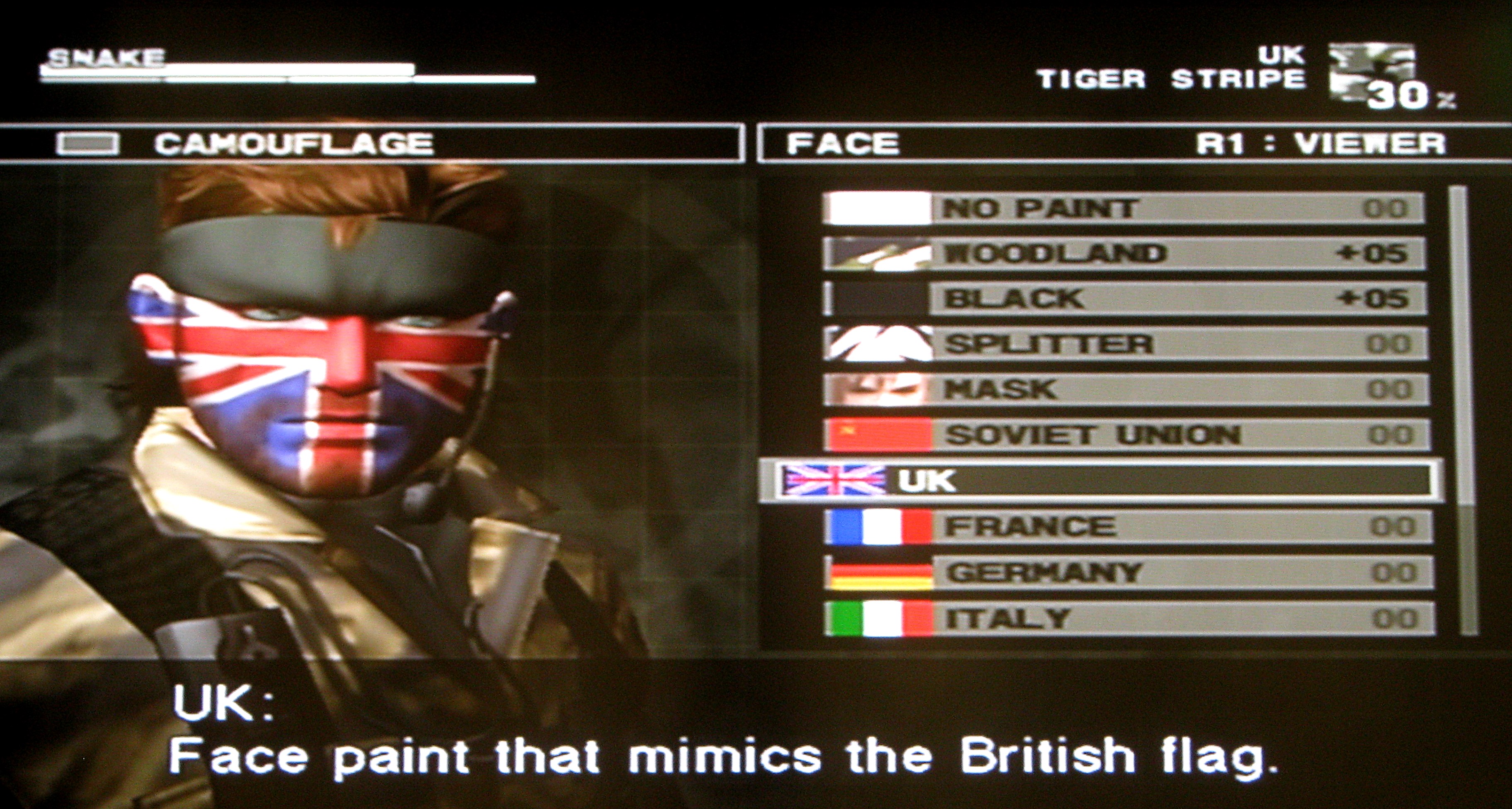
Another element of this stealth game is, of course, camouflage. When you are so used to titles like Fallout 3 where stealth is more or less optional games like this take a while to get used to. A plasma rifle would have helped in the jungle, but alas twas not to be. Plasma rifles make everything better. It’s strange; however, that face paint of the Italian Flag is seen as decent camouflage in the jungle. Apparently red and green work well as a disguise. In a similar fashion the Japanese flag works when sneaking around buildings – there is no accounting for taste. And it appears the UK flag just gets people even angrier at you… that might just be my imagination though. Well it does resemble a frowny face with angry eyebrows. That could well be actually, it would explain it.

Well, two down and four more entries in the Metal Gear Solid saga to go. Let’s hope they’ll work out as addictive when we get into them.

Final Thoughts

This game needs your time. Not just for the long cutscenes, but also to get into it. The first half hour of actual gameplay is dreadful. Then it speeds up a bit, you need to start sneaking to avoid your enemies, life gets tense and you enjoy your companions. The game gets going and gets good. From the interactions with your characters to the overall objective and big mission, everything slots in and starts working well together.

The game looks and sounds great, a good plus, helped by a far different and interesting setting, that by nature looks more interesting.

Even more interesting is the attention of detail in the game. You get the feeling someone has actually tasted these animals, and the movie knowledge can only come from a real fan. It’s cute and funny and adds to the realism. And it made me want to see some of these movies. Even if we’ve probably seen some on MST3k before.

#30 Frogger

Posted: 19th July 2011 by Jeroen in Games
Tags: , , , ,

70th game played so far

Genre: Action
Platform: Arcade
Year of Release: 1981
Developer: Konami
Publisher: Sega

Why did the frog cross the road?

Because he wanted to get home from work.

There’s premise of Frogger for you. Cross the road, avoiding cars, trucks, racing drivers, snakes, crocodiles and sinking in a river. It’s an old action game, and one of those we both remember well. I know I spent many an hour playing this game. It’s a noble goal you have, and a fun game to play it with.

Our Thoughts

Going back some time down memory lane, to Frogger… it was ages since I last played this game. And the reason we chose to play this next is because I suddenly had it in my head to find out how to procure myself a pet toad. Oh the japery! These sudden outbursts can be quite… interesting at times. In spite of this I am very glad that my tangential thinking led us towards playing Frogger.

I believe that in our review of Peggle we talked about how much the KISS (Keep It Simple, Stupid!) Principle leads to some incredibly addictive gaming. It’s a bit of a glib idea but it can be found in most games on this list in the first fifty chronologically. So I apologise in advance for mentioning KISS when we cover the likes of Arkanoid, Pac Man and Asteroids.

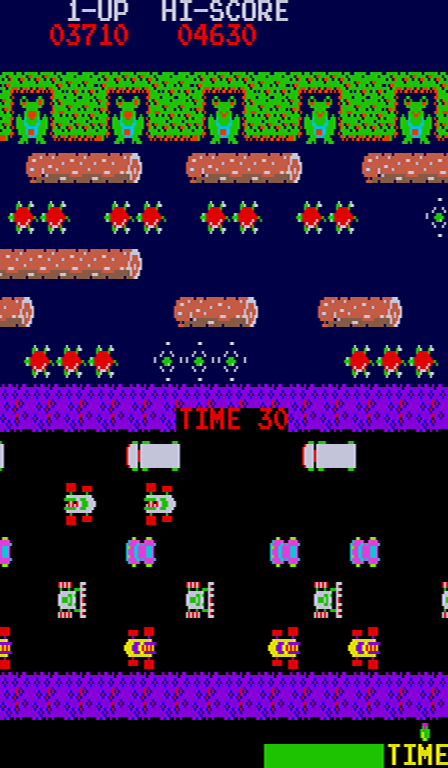
Possibly more than even that – a lot of arcade games are like that. It shows how things changed, but also how casual games are still popular. While these days, many of the expensive games feel like they should require some time investment, simple games like this provide you with a good opportunity to jump in and play immediately. Frogger clearly have this down: Your frog just jumps backwards, forwards, left and right. Avoid the cars and don’t drown in the water. That’s all you need to know. And yet it’s addictively hard.

It really helps that every level adds something new; faster cars, snakes, crocodiles and even a malevolent looking otter. Do otters even devour frogs… South Park taught me that they liked clams. They still seem dangerous.

Aside from the quaint graphics and the delightful 8-bit noises there is not too much more to mention about this game. It’s fun and addictive. It’s very retro, but the gameplay is good… and for me, the memories are better.

Final Thoughts

Are you one of the few people never to have played Frogger? SERIOUSLY?! Fine…. visit this site and you can play it for free.

#805 Zack & Wiki: Quest for Barbaros’ Treasure

Posted: 15th July 2011 by Mulholland in Games
Tags: , , , ,

69th game played so far

Genre: Adventure/Puzzle
Platform: Wii
Year of Release: 2007
Developer: Capcom
Publisher: Capcom

Another day, another Capcom game. Yet… we’re not bored yet. Gimme a high-five Capcom…*crickets*Fine, we’re never going to be invited to a game unveiling where we can rub shoulders with Capcom execs whilst we pocket the Hors d’oeurves and avoid the fire-eaters but we can dream.

Ever since we played Drop 7 we of Pong and Beyond have been attempting to limit the number of puzzle games we cover since we had already covered more than we had meant to. I missed them so much so I’ve been really looking forward to the titular mouthful that is Zack & Wiki: Quest for Barbaros’ Treasure. Golden money ‘an all.

Our Thoughts

This title just looked strange from the start, and having played it, it has only become stranger. There were reportedly about 200 names drafted up for the game and this is the best they came up with. On the one hand I can see what they did there since it makes sense on a number of levels. It namedrops the two protagonists as do games such as Ratchet & Clank, Banjo-Kazooie and Jak and Daxter, it describes exactly what the game is and it has great kid appeal. It ticks all the boxes and it misses the point completely. Whilst in Japan the childish, anime-feel has universal appeal the name and cover art only really appeals to those under twelve. Thus it has remained largely unsuccessful in the West – much to the chagrin of critics and Capcom-fans who really fell for this game.

When you play the puzzles you can see their point as their complexity ramps up very quickly to the point where very lateral thinking is needed. I would love to see the eight year old who could solve all the puzzles without a visit to an online walkthough… or not as they would be some kind of wizard. In fact, while we might have worked it out ourselves more often, in the interest of time we used one once or twice. Part of this is due to the strange mechanics this game sometimes offer. In particular, the animals transforming into items when you ring the bell that’s called ‘Wiki’ (it somehow eventually makes sense) seem random. While a mole turning into a drill makes some sense, a boar into a hammer is harder to understand, and a bat turning into an umbrella simply seems insane. The thing that really helped with this game is having another person playing it with you to offer a fresh perspective on a puzzle. An advantage we obviously had.

The thing that makes this game really interesting is that it is a very rare example of a well executed console-based point and click adventure game, which actually makes this the first within that genre we have covered. Somehow I thought it would have been either Broken Sword or Sam & Max (there’s another eponymous duo) but that’s what happens with borrowing. Not that I’m complaining… I’m not… I really enjoyed this game despite the fact my arm ached from the fishing minigame. Some of the funniest and most clever games in that sense are still coming up… to the point where Sierra’s offering was mostly ignored in the list in favour of most of the Lucasarts catalogue.

One of the good things about this game appearing on a console is that it makes full use of the Wiimote’s capabilities. Aside from the pointing using the Wiimote, a lot of actions you take are actually movements made using the controller. This is rarely strictly necessary – turning a key might as well be a click instead of you actually doing it – but it  makes it a bit more immersive and clever. It is still, however, used for good measure in a few puzzles, such as defeating a fish by trying to reel it in, as well as a music-based minigame that comes back on several levels. There are very few games made by third-party developers that have used the Wii controller in such a versatile fashion. True games like Okami and Dead Space: Extraction have also been praised for good Wii controls but neither contain as much variation in Wiimote movements that can be found in Zack & Wiki. And while they may seem gimmicky at times, they’re still better than the ewww-factor implicit in the Wiimote use in No More Heroes. Even if there is a half-naked man in the top-right hand corner of the screen shaking the Wiimote like an empty ketchup bottle. True, it’s close, but the graphics make everything look a lot more innocent.

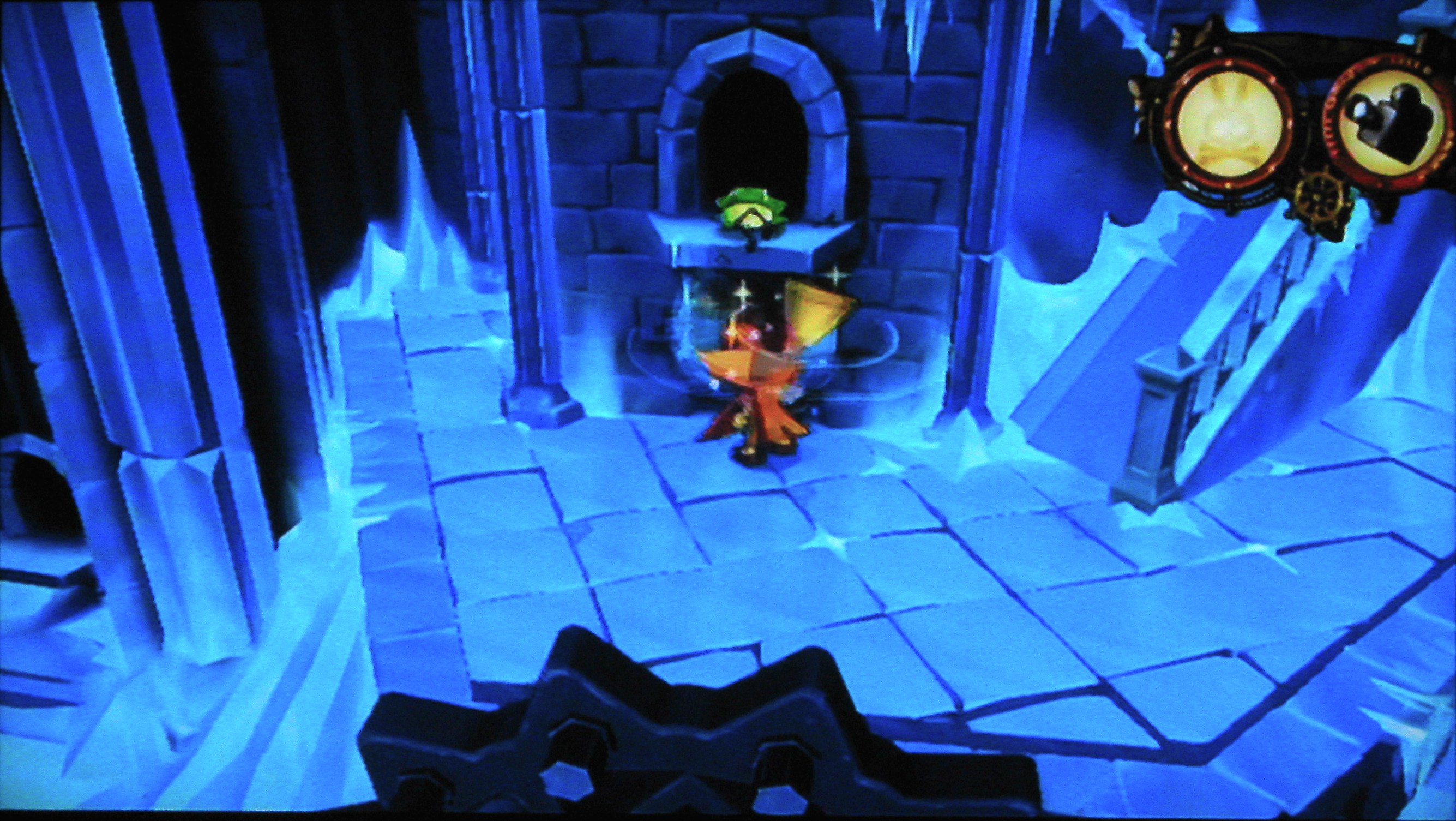
The graphics, as so many things in the game, are quite Japanese – anime-like. There’s an element of kiddishness in there, cute and cartoonish. They’ve even kept the original ‘dialogue’ noted by Wiki’s occastional cry of “Zakku!” Something that was easy to do as they were mostly cries of ‘Alright’ and similar.

One thing we have neglected to mention is that this game is pirate-themed. Something that was just falling out of fashion upon the game’s release and which makes it more surprising that this was not commercially successful.  Who, on some level, does not like pirates? It’s not a big part of the game – it has no impact on the actual game, and really only influences the look and feel of some parts – but it makes it fun.. And in a way cute, when you consider Zack looks rather young. That isn’t helped by the fact that he chomps on a chocolate bar whenever left idle. It was added as an afterthought, and you can see that sometimes. Even so, it doesn’t make the game any less cute, and it certainly helps give him a reason to collect treasure… what more could you want there?

Final Thoughts

So our little pirate guy? Aside from the fact that it’s a pretty good game, it’s also a good adventure. It’s not entirely like the original point and click games – the story is fairly flimsy and not the main drive of the game – but it has some interesting (and at times obscure) puzzles to work out. It’s also a very nice-looking games with some very strange and fun environments – the water slide in particular making me want to go down them.

The controls have their issues and make the game harder to control sometimes, but most of the time, when it works, it works well, and out of everything, it’s the use of the Wiimote that truely stands out during this adventure. That and the cute bell-monkey. He’s just adorable. Ding!

Those who know me, probably know that for the most part, I’m a PC gamer. Sure, I have my handheld games, and been doing more console gaming, but PC gaming is where I’ve started, PC games are the ones I own most of, and the PC is where I prefer to play.

There are a few advantages to PC gaming. One I like that I’ve touched on with Baldur’s Gate II is the customizability. Yeah, you’ve got the existing game, and that’ll often be good enough. But sometimes it’s nice to be able to change things. Add features or levels for some games, using the provided editors or fan made ones. Would a game like Starcraft or Neverwinter Nights have worked on another platform? It seems unlikely.

Just as applicable sometimes are fan-made patches. A company often doesn’t want to keep supporting a game and keep patching it. The game is too old – there’s no money in it – or they don’t have the time or money to do so. If fans like it enough and have the capability to do so, they’ll jump in and write fan based patches. There’s several games that gained a shelf life because of this. Sometimes even core code is rewritten to support this, such as in the ScummVM engine… without it, it’d be a lot harder to run an older game.

Technically not allowed, according to the license agreement… but if it means the game keeps running? Adds more to play? It’s not a bad thing and is, in fact, sometimes a reason a game gets sold more often. It doesn’t hurt.

Related to that is a larger advantage: backwards compatibility. Looking at the current consoles, the Wii has backwards compatibility with the Gamecube… but don’t try to play anything older, you need a rerelease for that. The XBox 360 has limited compatibility with XBox games… they might work when patched, but there are no guarantees. PS3 backwards compatibility is even stranger – old models run PS2 games, but newer ones don’t, so you’re out of luck with them. Then again, it does support PS1 games. Handhelds… get more confusing, with the DS only in some models supporting GBA games, and the 3DS only supporting DS games.

PC games are supported as far back as we can go. You might need the help of DOSBox, or do a bit of Googling to get a solution, a compatibility patch or something else. The fast, fast majority of games, whether they’re 2 or 20 years old, will work on modern machines with a bit of luck.

And then we don’t even consider emulation, which allows support of other consoles. Legally not right in all cases, but still an option.

The PC has the bigger gaming library, thanks just to backwards compatilibity… although at the same time, if games aren’t exclusive, a PC port tends to be fairly common, compared to other platforms.

Then there’s upgradability – it’s easier to upgrade a PC to get a better video card, CPU or have more memory. Cheaper integrated machines just work, or if you put in some more money, you can build it the way you want to. Cost is the major factor here – a PC is more expensive than an average console.

Its many other uses help here though – there’s more you do with your PC than just play videogames. Other consoles aspire to this too, but don’t always reach it entirely.

There’s a lot of PC games on the list that we have yet to cover. A number of these could do with a good PC – either to run, or to make sure we can get the best performance of it – graphics and sound.

And, to be honest, I’ve always dreamt of having a proper, up to date gaming PC, one that’s not behind, that can run every game I throw at it. I want the gaming PC I like as a PC gamer.

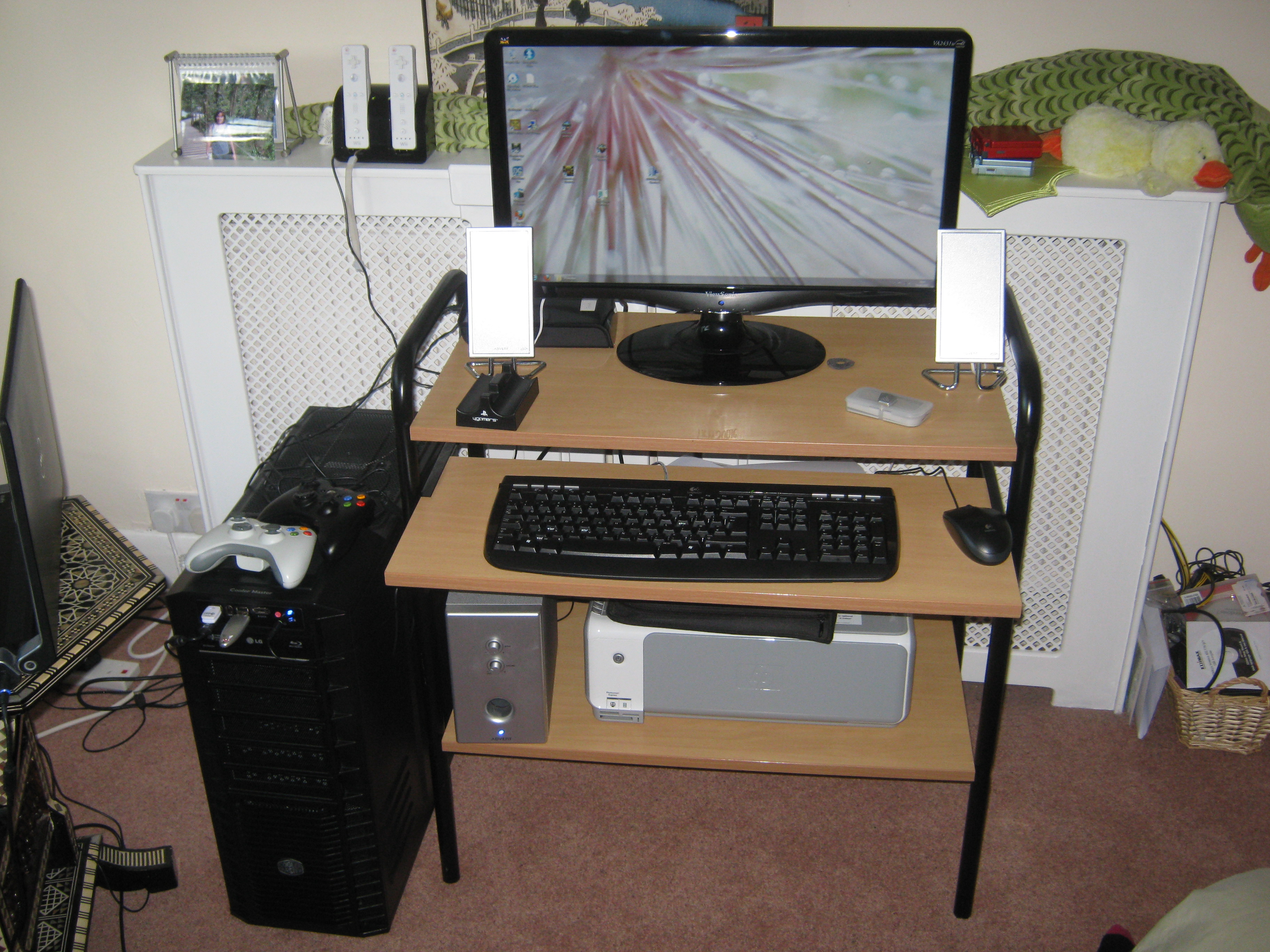
So after saving up for a long time, that’s what I did. I got a proper PC like that for our use. And here it is:

Six core 3.3GHz CPU, 16GB memory, 6970 ASUS Crossfire card, 24″ widescreen monitor (up to 1920×1080) and several other goodies. It’s a monster and has been named such, now being known as the Kraken. But it’s worth it.

You’ll see a lot more of this. When you see another PC game come up in the list, you now know what this has been played on.

For I have touched my future, and it is awesome.

#671 Shadow of the Colossus

Posted: 11th July 2011 by Mulholland in Games
Tags: , , , ,

68th game played so far

Genre: Action/Adventure
Platform: Playstation 2
Year of Release: 2005
Developer: Team Ico
Publisher: Sony Computer Entertainment

I will be completely honest here: this was a game I was hoping to save for a more landmarky sounding number. Instead here it is at lucky sixty-eight.

Few games sit in the same position as Shadow Of The Colossus; a critical and cult hit that most game-buyers are unlikely to have heard of. In fact it probably reached it’s widest audience after a rare favourable review on Zero Punctuation. The sad fact is that because this game is so beloved in the cult world it sells for a large amount of money for an old PS2 game. Thanks again Kat… but we’ll have to get our own version of this one day.

Our Thoughts

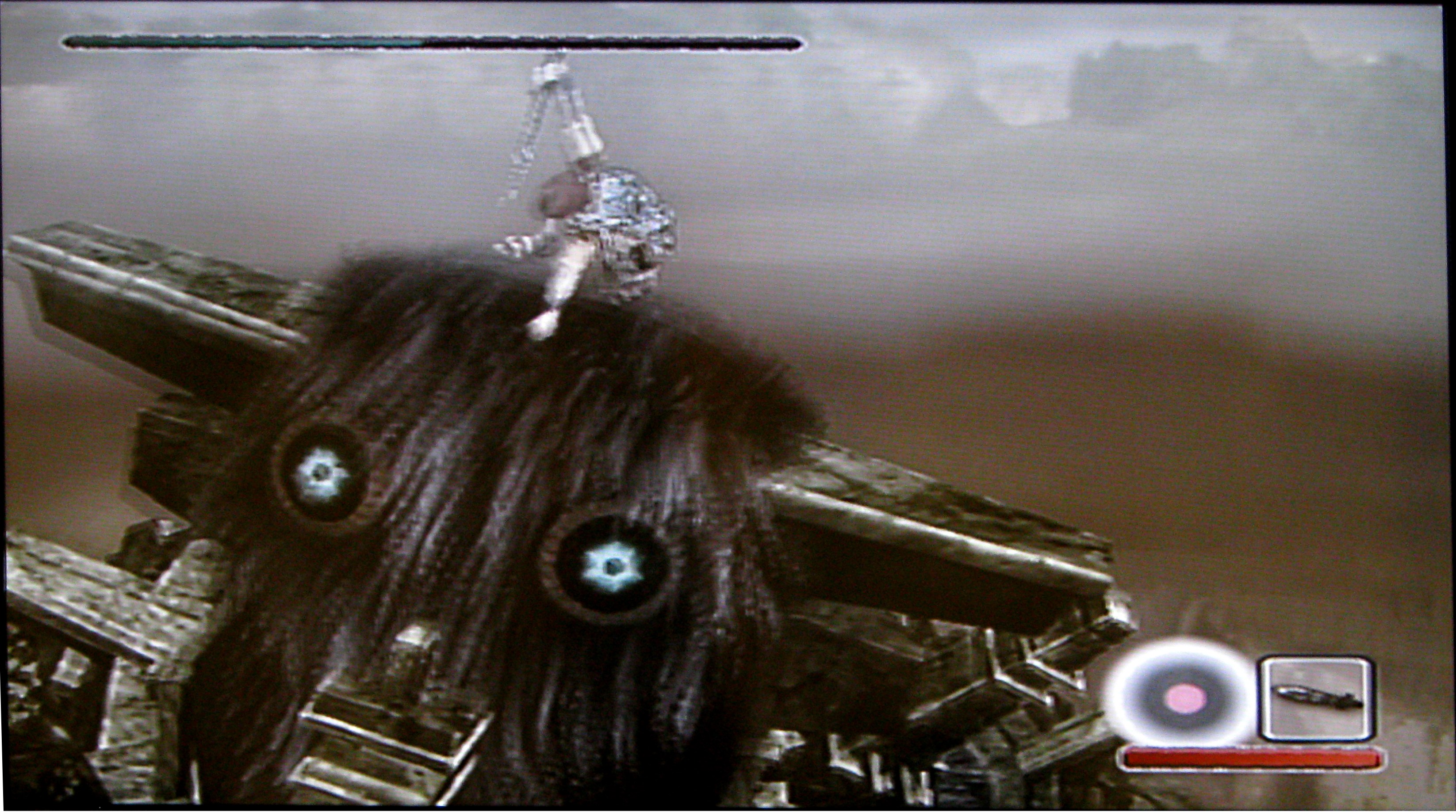
There’s some games you know are epic, but where you keep finding the lesser bits between the gold, and they take over occasionally. I think Shadow Colossus felt like one of those. I think the shorthand for that is “flawed masterpiece”. If you wish, I just thought it was better when descriptive. The dividing line here is somewhere between the colossus battles and the long treks to get there.

To start with the latter, the environments are gorgeous in this game, but there’s a lot of nothing to travel to. Even that’s okay, except that the controls work against you here sometimes, and getting past them can be timeconsuming consider they’re the bad part. The thing about the battles and the long searches on horseback is that they provide a great deal of contrast. I mean this can be seen with the soundtrack which is light and airy as you gallop around the rolling hills and then becomes far more intense during the battles. In a way it prevents the game from feeling like a one-trick pony and instead greatly contributes to the games atmosphere.

Before we go further here is the crux of the game: girlfriend dies, you travel to a forbidden temple to have her ressurected by some evil spirit, kill 16 ancient colossi to achieve your goal, the end… ish. It’s a tale as old as time but, in the end, there is a great deal of moral ambiguity to this as you play along.

In the end none of these colossi are malevolent and the first only attacks you after you present yourself as a threat. After you hack away at his shin and eventually fell the giant moss covered golem word basically gets out and the remaining 15 attack you in self-defense. Even then they rely more on strength than guile and you mostly win by outsmarting them. This is the equivalent of mass genocide where the victims are the Ents from The Lord of the Rings. After destroying colossus number three I actually began to feel pangs of guilt about what I was actually doing.However, you are keen to progess because the designs of these massive foes are so fantastically beautiful that you want to see what comes next. Especially since you need to concoct unique methods to destroy each of them. Which is the point where the adventure/puzzle part of the game comes in.

While your magical (ancient) sword can show the weak points of the colossus, you need to find out the specifics on where and how to get on it. For example, with one colossus you need to get it to beat down on a stone circle, which destroys a ring on its arm preventing you from climbing up to the weak spot. Some of these are more obvious – and easier – than others, but because they are all different, each of the 16 battles is a different battle that requires different strategies. This means that while there may only be 16 battles in the entire game (ignoring a small amount of hunting you can do), they are 16 big, epic battles. These shine in designs, graphics and complexity – I know no other games where you use your foe as battling platform, outside some particular platformers where this is only barely the case. Here, the creatures move and try to shake you off while you hold on for dear life, trying to reach that one spot.

Some are cuter than others, and all are this strange mix of furry animal and stone artifact buildings, which makes it a bewildering experience. This isn’t helped by you not getting much story information. You don’t know why they’re there, what they’re doing, who created or bred them, if anyone, or else what their ancestors are, you just know they’re there and you need to kill them.

The main problem with this game is that it can be immensely frustrating. The fact that your health gradually regenerates is a godsend but it does not counter-act the pounding your head against a porcupine-style moments than being flung off of a colossus for the upteenth time. It’s not particularly difficult since you can run in circles until your health gauge fills up but be prepared that battles can take in excess of half an hour… and there is no mid-battle saving point. I also got annoyed by a particular jumping puzzle that took ages – due to bad camera handling and the fact that you had to swim back after falling and climb back up to a great height, which took a few minutes every time it happened.

At least they were able to get the proportions feeling suitably epic. I mean the world appears to be massive and the colossi  are… well… colossal in stature. As your character clambers up their leg he really looks like the ant getting ready to ruin your picnic. Except with what’s apparently a very powerful sting. It’s a suitably epic game, occasionally flawed, but very much giving the epic fights that make any game great. And its focus on just that works great.

Final Thoughts

Okay okay we’re officially bad people for killing these innocents. We might as well fund a game that simulates water-boarding now where you use a Kinect controller to hold virtual buckets of water…. or am I going overboard.

In the end this is a game which truly justifies the term ‘flawed masterpiece’ and really provided a flashpoint in how games were made. Nothing out there is quite like it… so just play it for yourself.